HIKING ALL 4 PEAKS OF MOUNT HUASHAN WITH KIDS AND A SPONTANEOUS VISIT TO TERRACOTTA WARRIORS
-
Hits: 783
I had seen amazing photos and videos online of Mount Hua(shan) even before we moved to China. The cloud-covered jagged peaks, the steep staircases carved into the cliff, and the narrow pathways along steep mountain ridges… It was definitely something I wanted to see and experience for myself. An end of May holiday weekend was a perfect time of year to escape the urbanization of Beijing and visit a destination close to my heart. Mountains, rivers, forests, oceans… nature was where I felt the happiest.
Not to be confused with similarly named Mount Huangshan (the Yellow Mountains) near Shanghai, Mount Huashan was a 5-hour high-speed rail journey south from Beijing. To give ourselves enough leeway in case of unfavorable weather, I had allocated a total of 4 days for this trip – 2 travel days and 2 days for the mountain.
Unfortunately, the closer the start of the trip came the worse the weather forecast got. Eventually, just a day before we had to leave, it showed 4 constant days of rain with cloud ceilings just above 600 meters (1970ft). Considering that Mount Hua’s peaks reached over 2000 meters (6560ft), that meant more than half of the mountains were predicted to be hidden in rain clouds… That was not encouraging. But with no other time available in near future to reschedule this trip, we decided to push forward and take our chances.
DAY 1 – TRAVEL AND ARRIVAL
With over 5 hours on the train, this was our longest rail journey in China so far, but it went by surprisingly fast. Soon enough, we were making our way through Huayin train station looking for our hotel owner who had arrived to pick us up and give us a ride to the hotel. It was quite common in China for hotels to provide free transportation to the lodging from major near-by train stations.
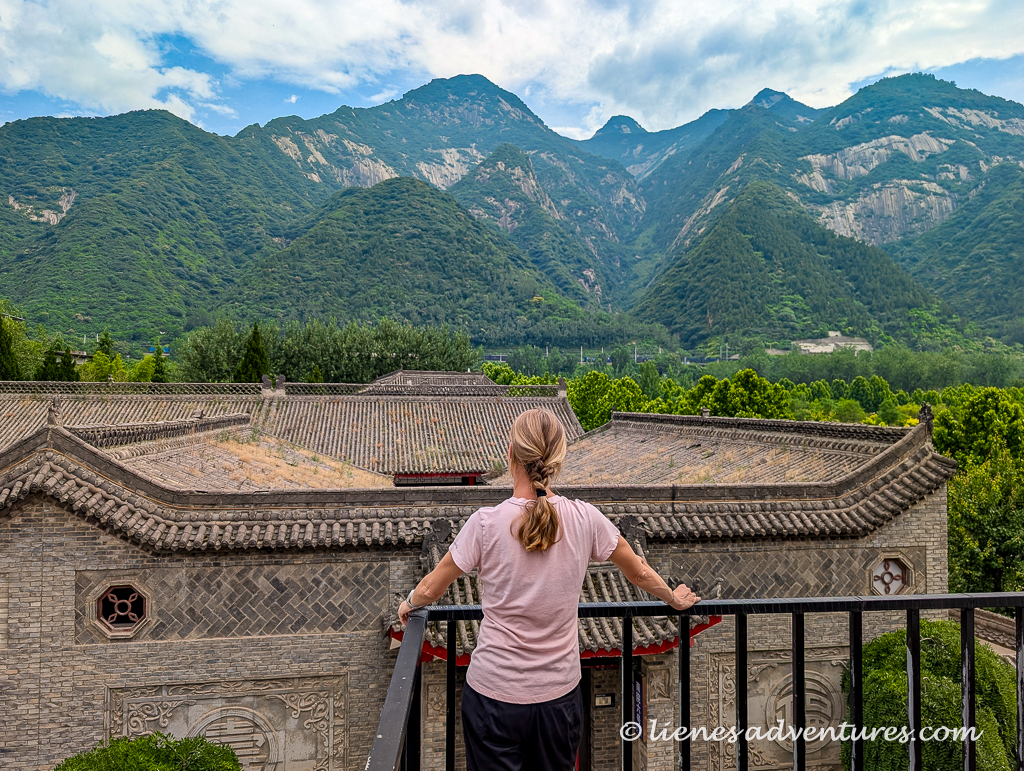
I had booked us a room at a privately-owned guest house / small hotel right at the base of the mountains for mere $28 per night! The view from our balcony and hotel’s patio was just breathtaking! We took some time to just slow down and admire the scenery in front of us.
As it was already evening and too late to enter the Mountain Scenic Area, we decided to head out for a walk around town. It was not raining, so we wanted to use the opportunity to explore a little bit. Maybe this would be the one and only day we would actually get to see the mountains without clouds covering the peaks?
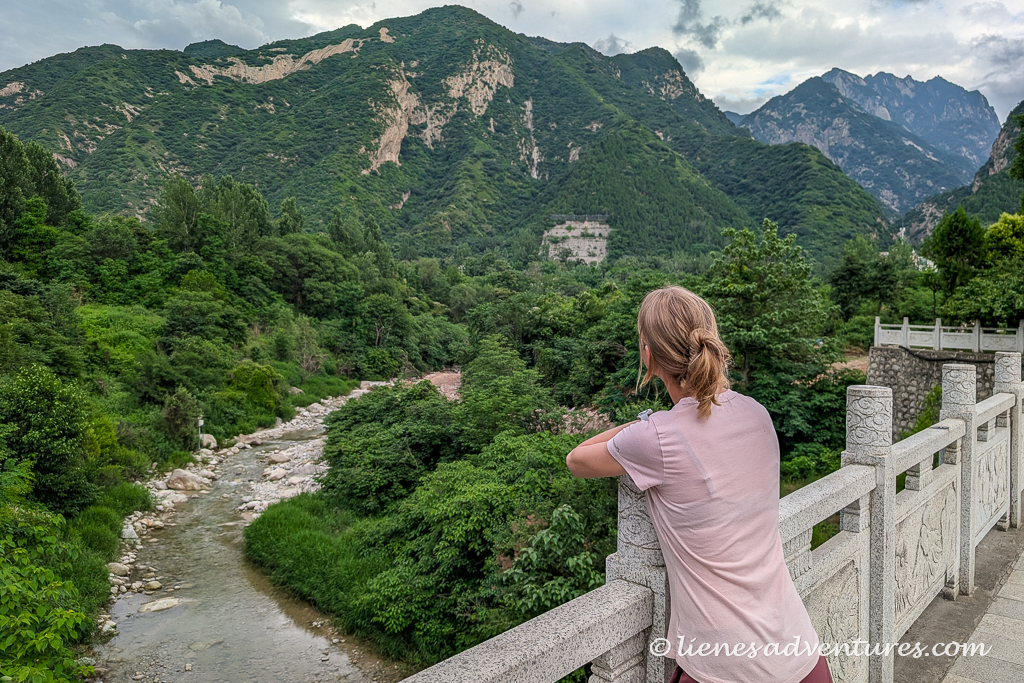
Everywhere we walked, there were beautiful, lush green valleys with a river and mountain background. We walked around until it started to get dark, and then returned to the hotel where the owner helped us plan the best hiking route for the next day.
DAY 2 – THE MOUNTAIN DAY
My alarm woke me up at 7AM. I pulled open the curtains and was greeted by…. not rain, not storm… but blue, bright sky with sunrays peaking through white fluffy clouds. What a complete opposite from all the predictions we had seen leading up to today.
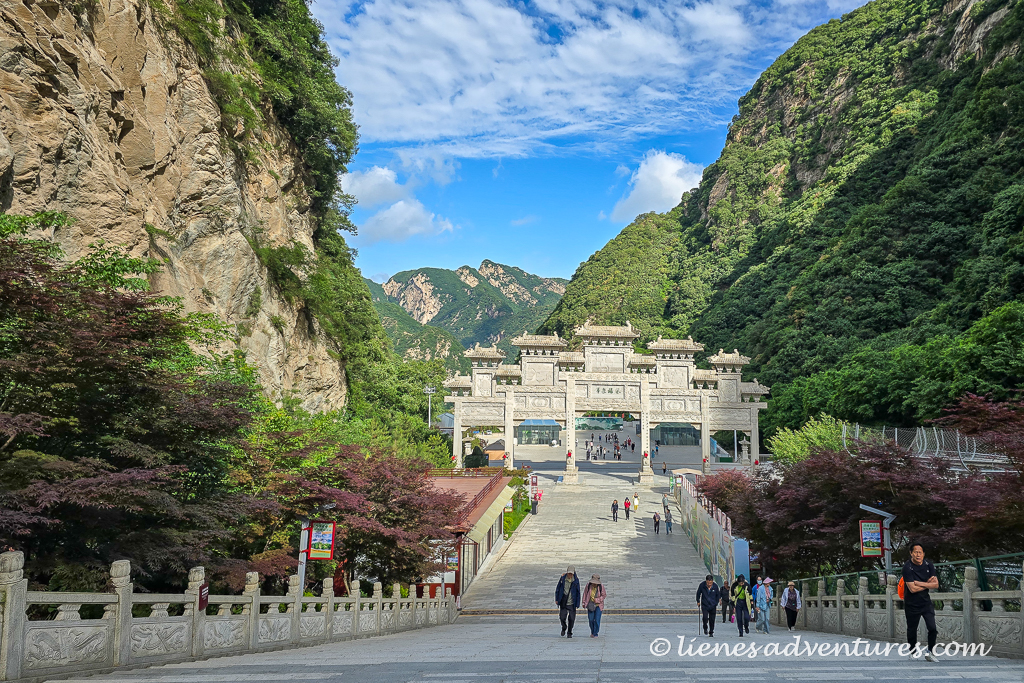
Our hotel owner gave us a quick ride to the Huashan Tourist Area and told us to call him in the evening once we were done so he could come pick us up again. While I expected crowds and loads of visitors here on a Saturday morning, we were just a few of barely a handful of people. I suspected that the awful weather forecast for the weekend had scared away many people, hence it was so empty. We walked to the ticket office and with not a single person in line purchased our park entry tickets within minutes.
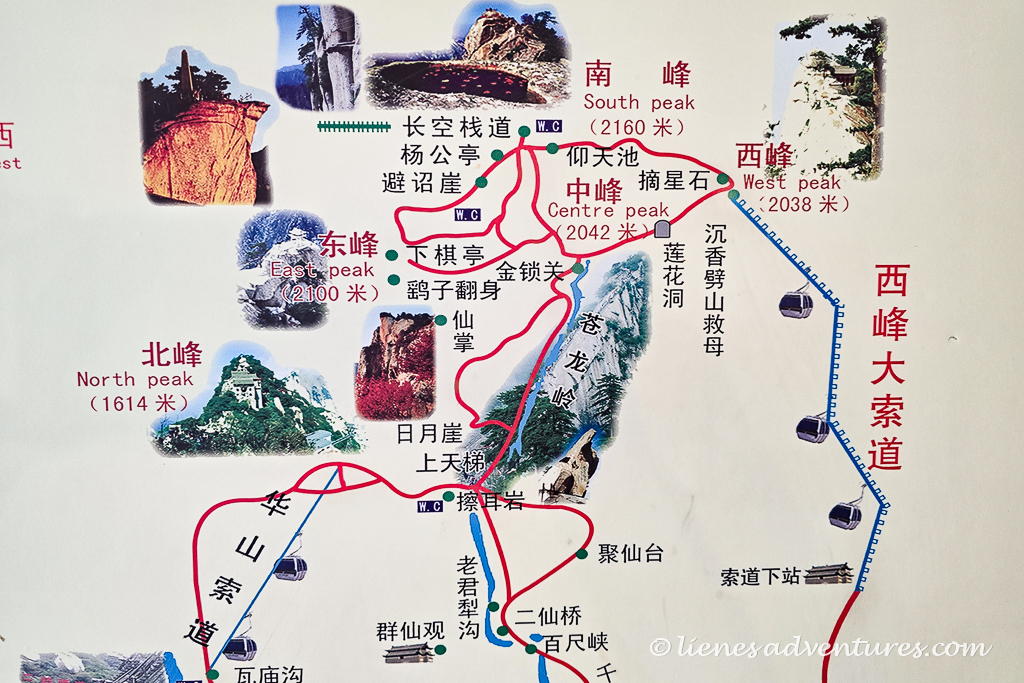
While there were many ways to conquer Mount Huashan, our selected route included visiting all 4 peaks of the mountain, which would be a full day’s adventure. Our plan was to take the West Cableway up; walk to West Peak; walk to South Peak; walk to East Peak; walk to North Peak; and take the North Cableway down. West to North direction had less elevation gain than North to West route. And most importantly, going West to North allowed me to avoid the Black Dragon’s (Canglong) Ridge - only 60cm (2ft) wide, steep trail section with bottomless drops on both sides, not good for kids or people with fear of heights (me)!
West Cable Car (up)
From the Tourist Area, a 40-minute park shuttle bus ride took us to the base of the main mountain. Here we purchased a ticket to the West Cableway, and without any lines, boarded the gondola. With over 4km (2.5mi) in length, the ride took over 20 minutes. And dangling nearly 1km (0.6mi) above the valley floor, my heart rate and blood pressure spiked quite a bit.
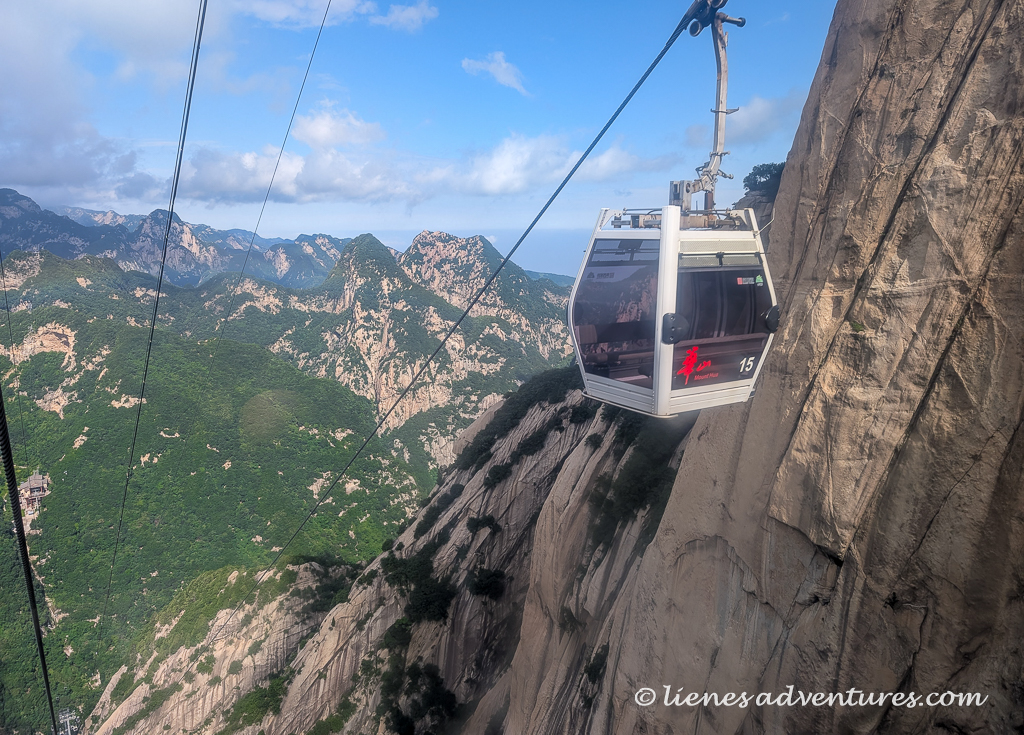
Although beautiful, it was not a comfortable ride for me. But my kids were just munching away on their ice creams, wondering out loud what would happen if the gondola fell… thank you very much for that image! After adrenaline-filled 20 minutes we were finally on top and ready for the day’s hike to start!
West Peak
Just a short stroll up the mountain from the cable car drop off, we reached our first peak – the 2082m (6830ft) tall “Lotus Peak”. Positioned to the west, it was famous for its sunset views. But even being here in the morning was equally impressive to us.
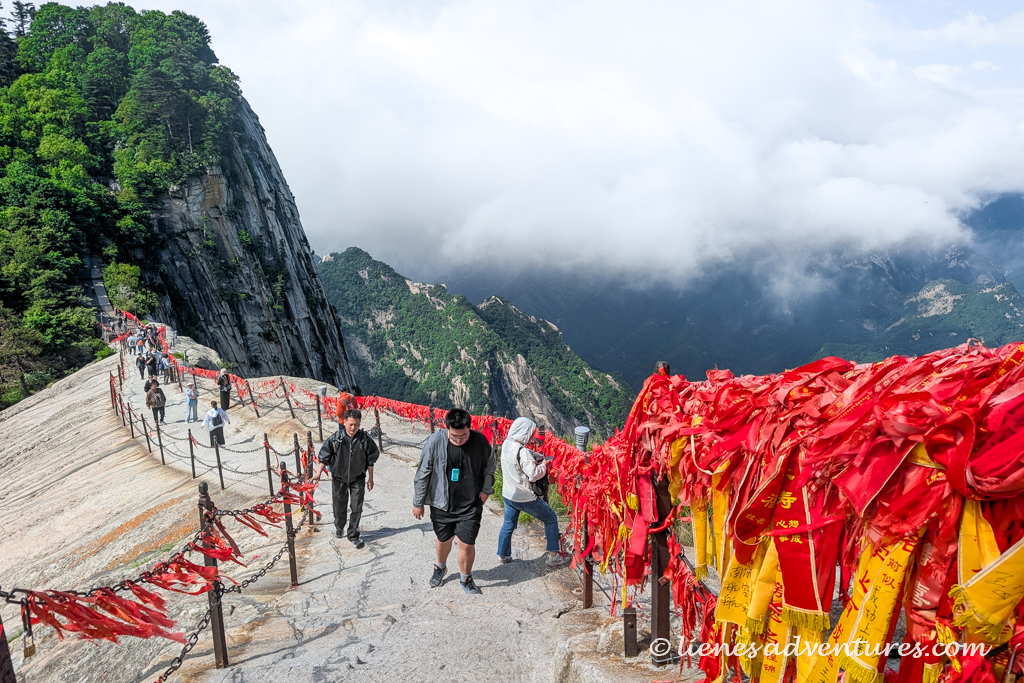
By now, the clouds had started to roll in, playing peek-a-boo with other peaks all around, giving the place a mythic atmosphere.
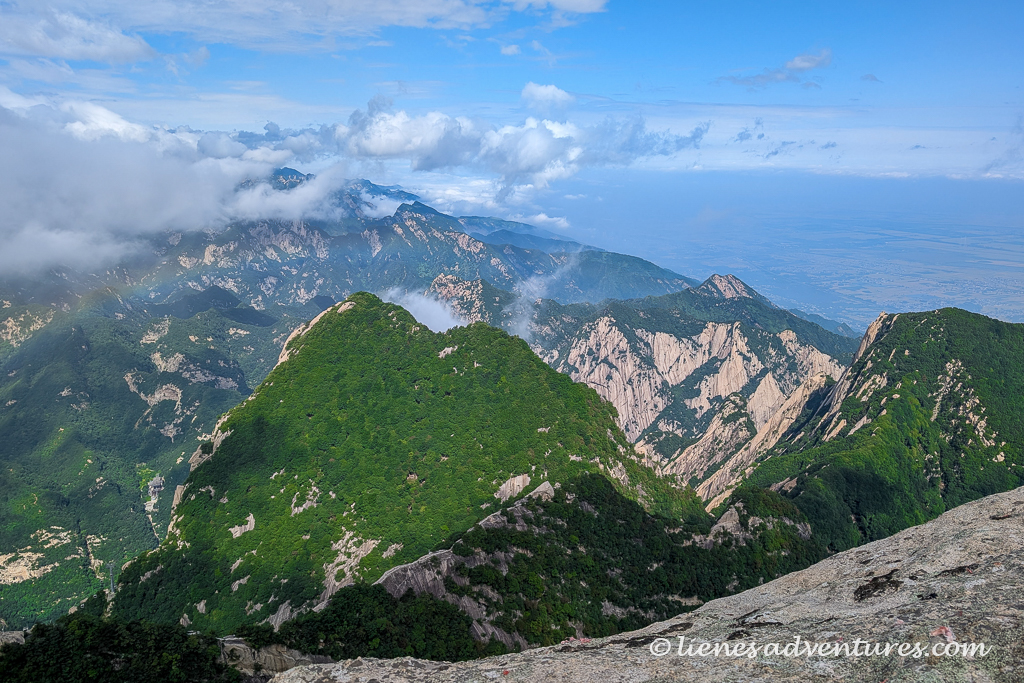
What people from Western countries might find different was that even in such remote and hard to access areas as this mountain, tourists could find temples, shops, food cafes and restrooms all along the route on top of the mountain!
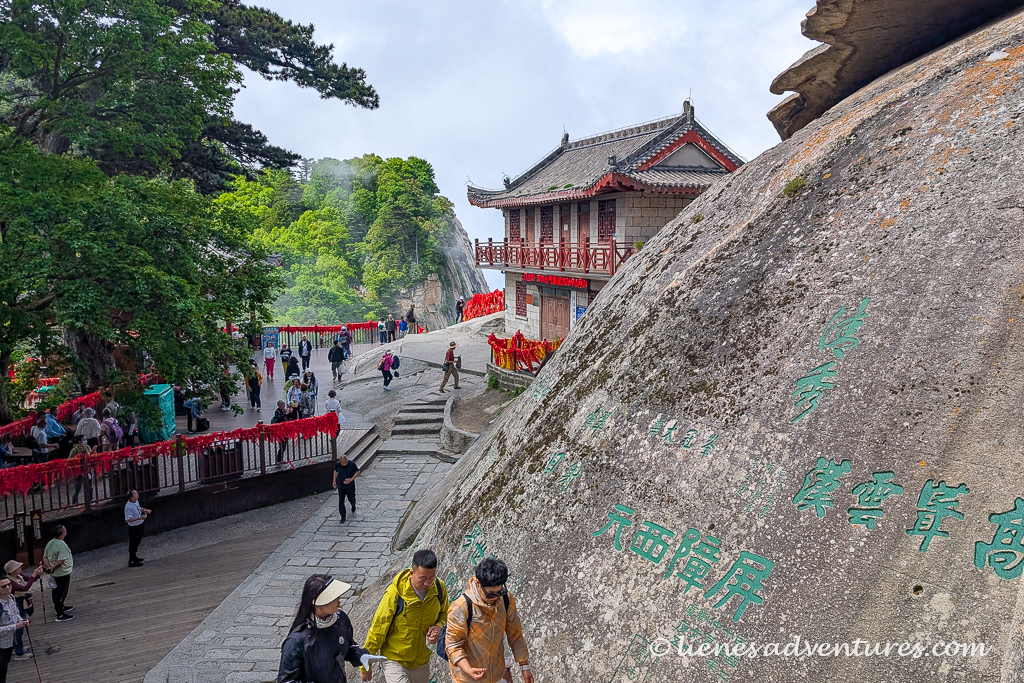
Being one of the 5 Sacred Mountains of China, Huashan had many Taoist temples built on its peaks. And near them, sellers were offering everything from food and drinks to souvenirs. Our kids wanted to purchase some cut watermelon slices, so we sat down and took a little break.
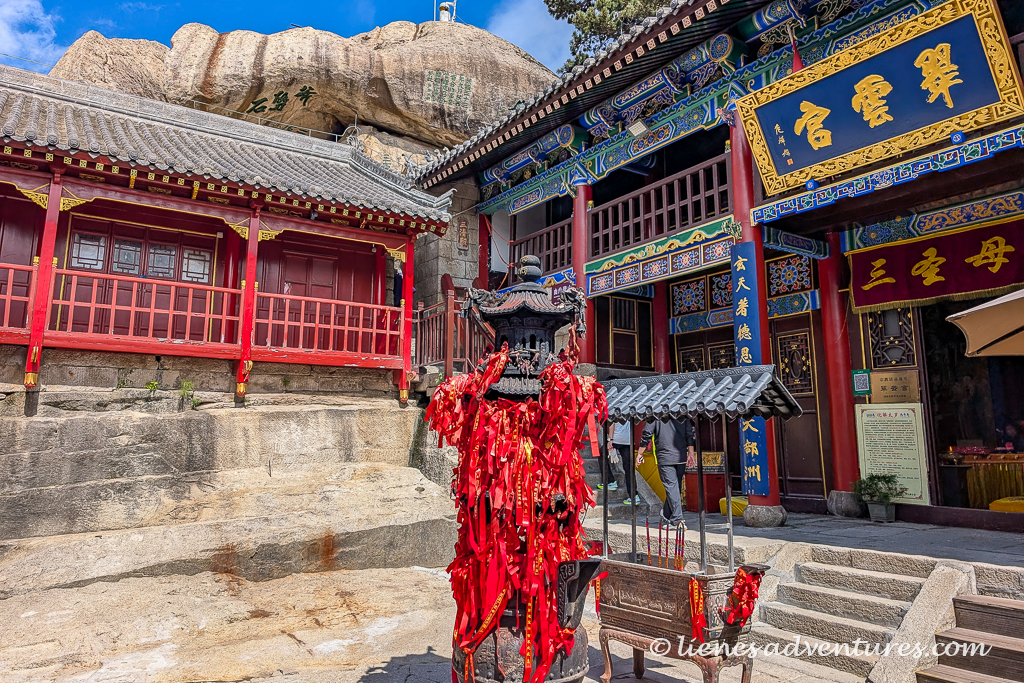
South Peak
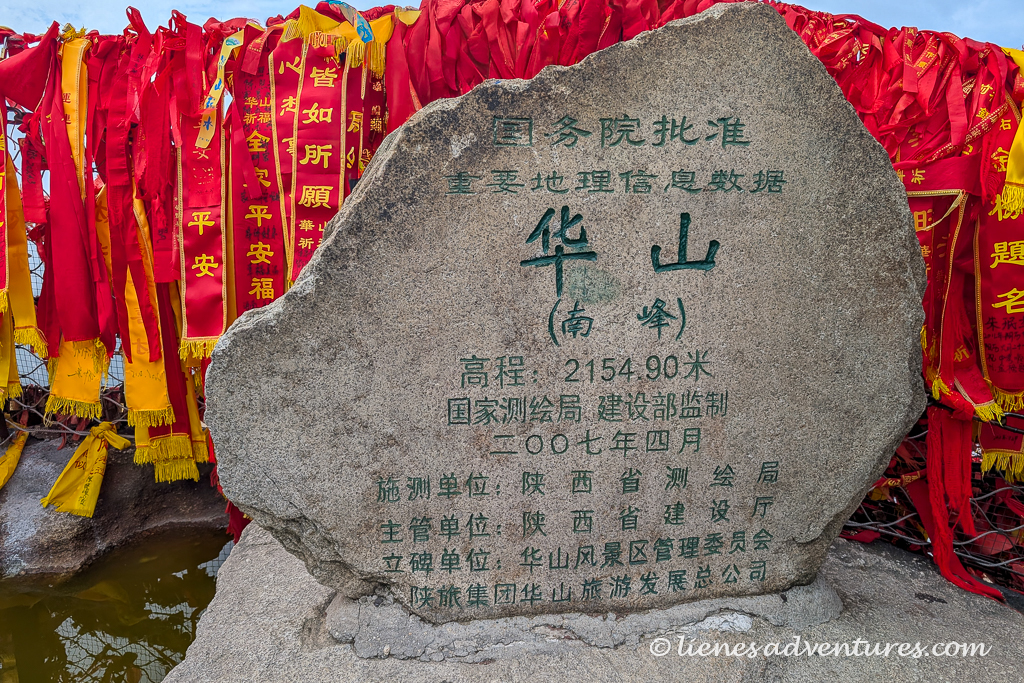
Our next target was The South Peak. With the height of 2154.9m (7070ft) it was the highest peak among all the five main peaks at Mount Huashan, and ancient Chinese called it the “Head of Mount Huashan”.
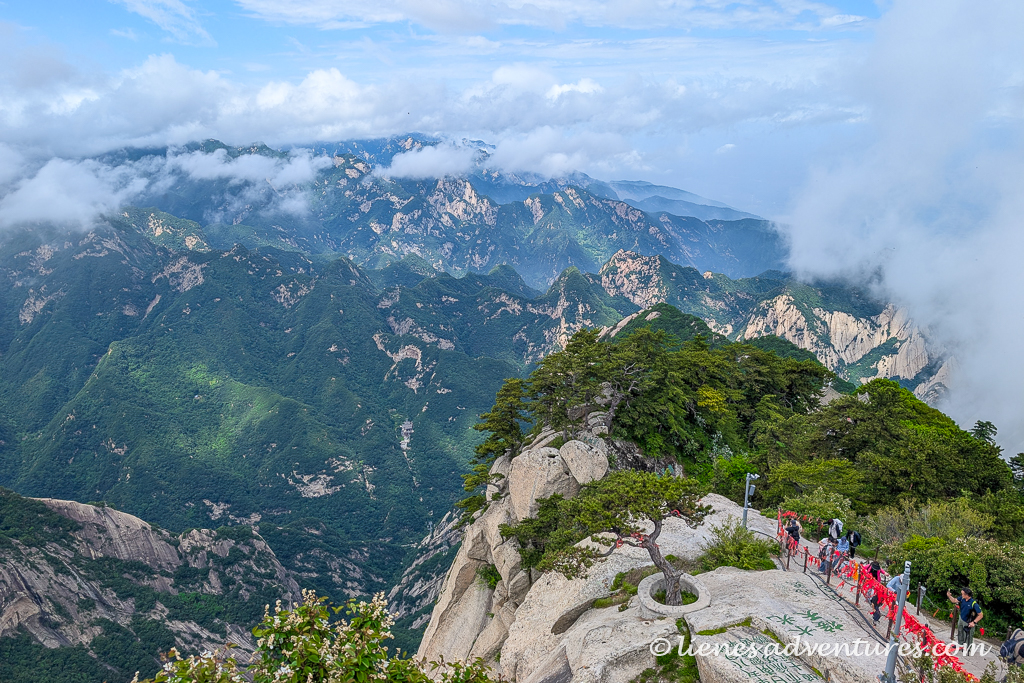
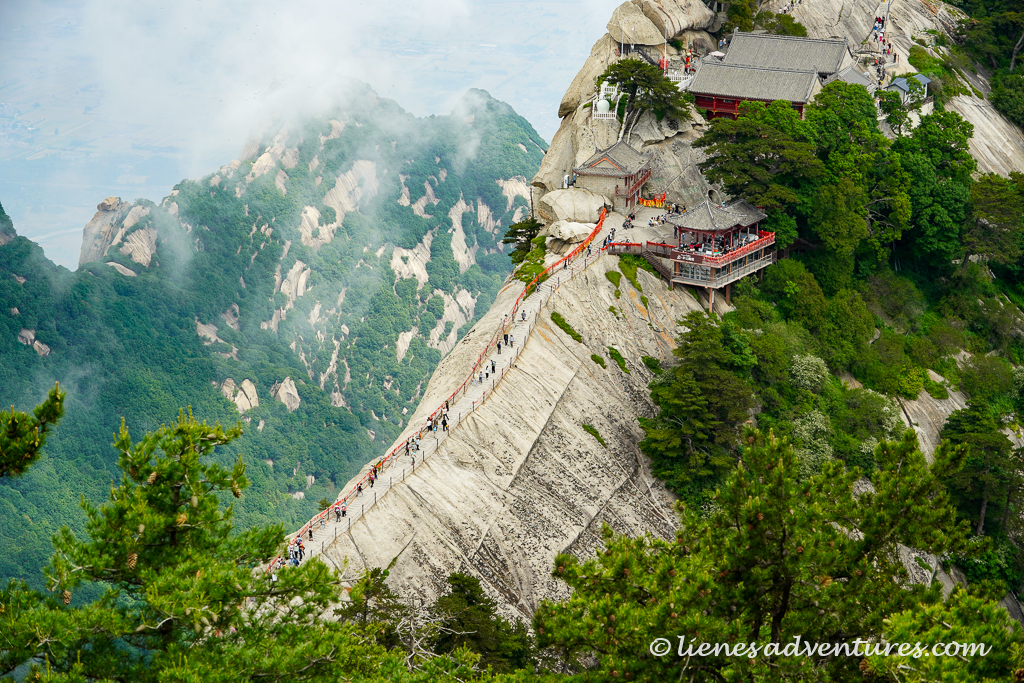
Going from West Peak to South Peak was mainly uphill, but the higher we got the more landscape opened up and the more stunning the views got. Looking back, we could see the narrow cliff walk we had just completed that lead to the West Peak.
Along the way, there were also local photographers who offered staged photos with swords and bows on a mountain background. And what little boy does not want some sword-fight photos? Our kids were all about it, and to be honest, the photos came out cute and are now hanging on the wall in their rooms at home.
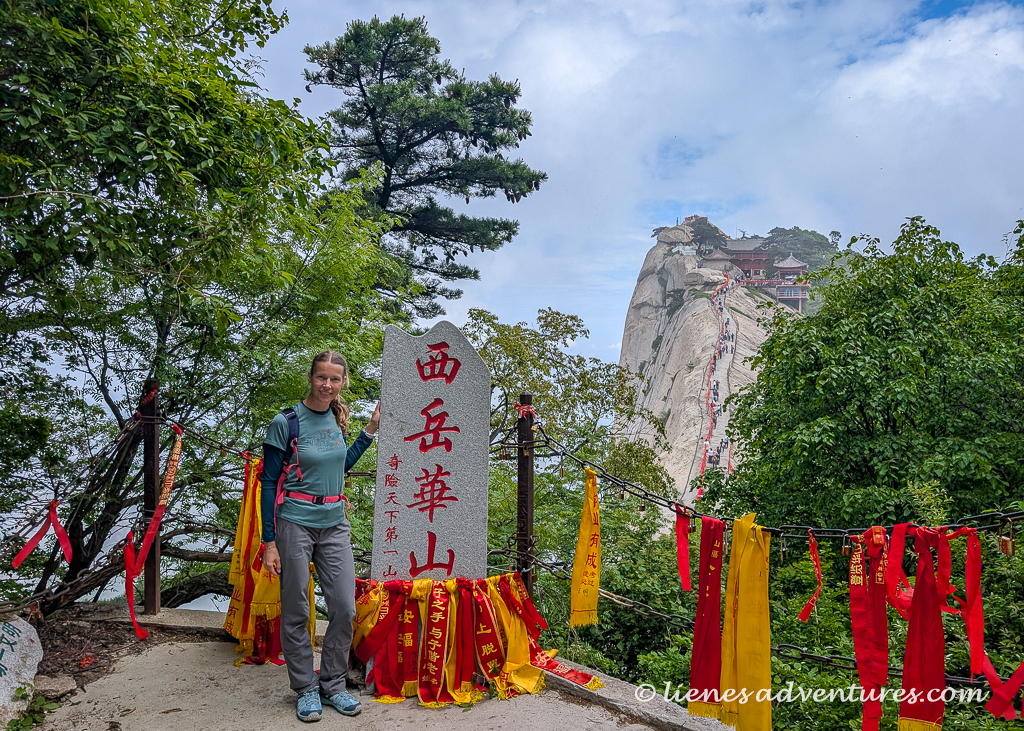
Little by little, we finally reached the highest point of the mountain – the South Peak! We lined up with other visitors to take a photo with the rock sign commemorating our accomplishment.
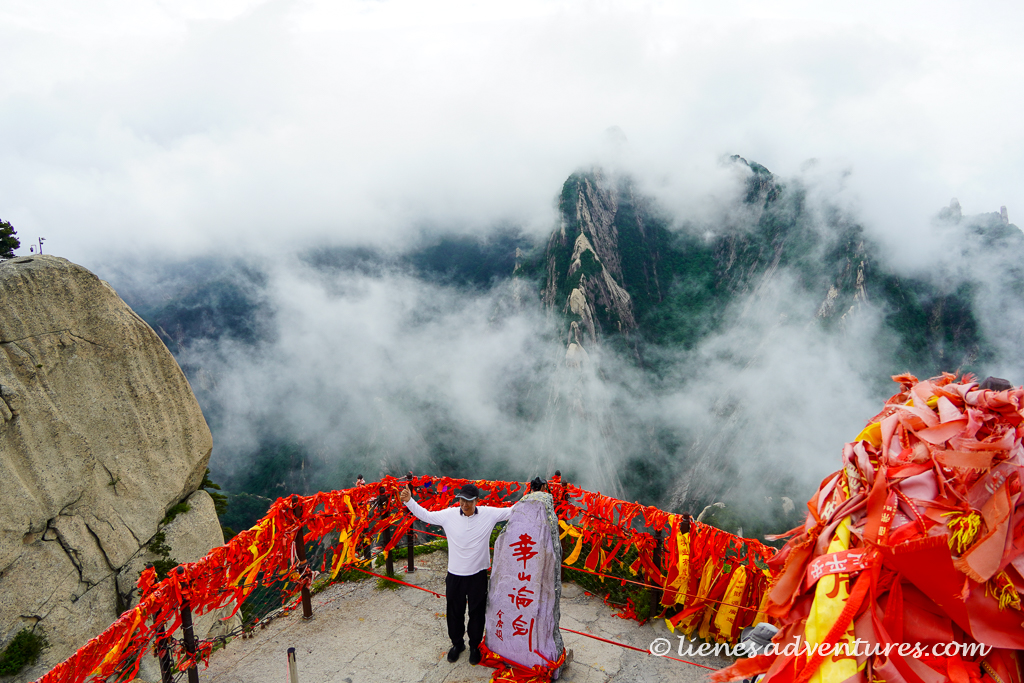
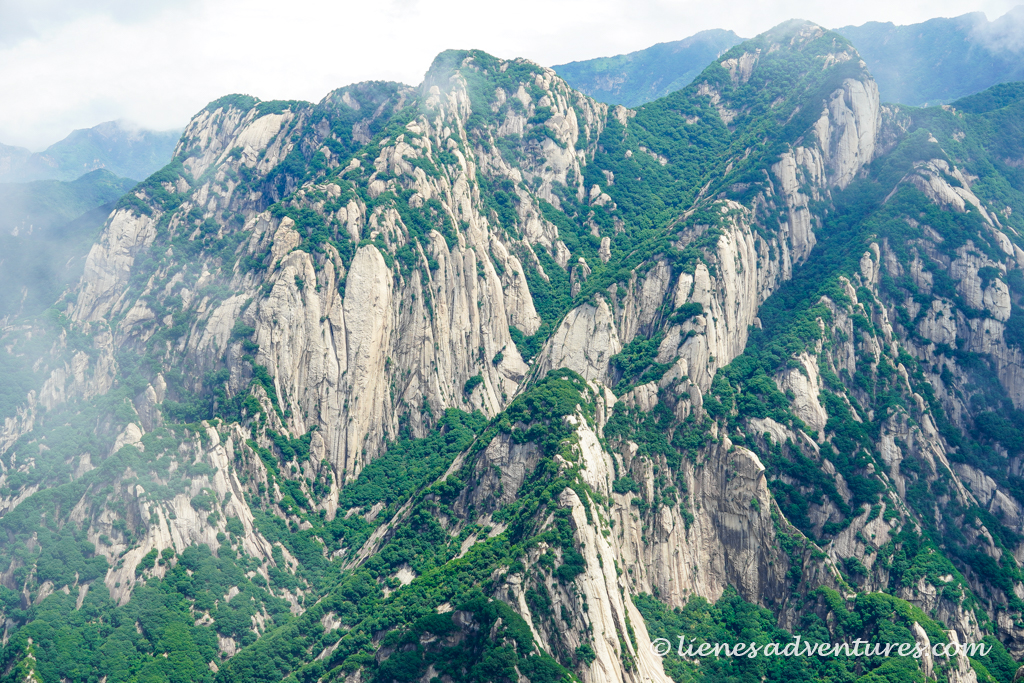
By now, the clouds were rolling in and out constantly, changing the landscape by the minute. Where we could see peaks just seconds ago, everything was suddenly white. But where we could see nothing before, jagged peaks had opened up changing the scenery completely. It was constant movement…
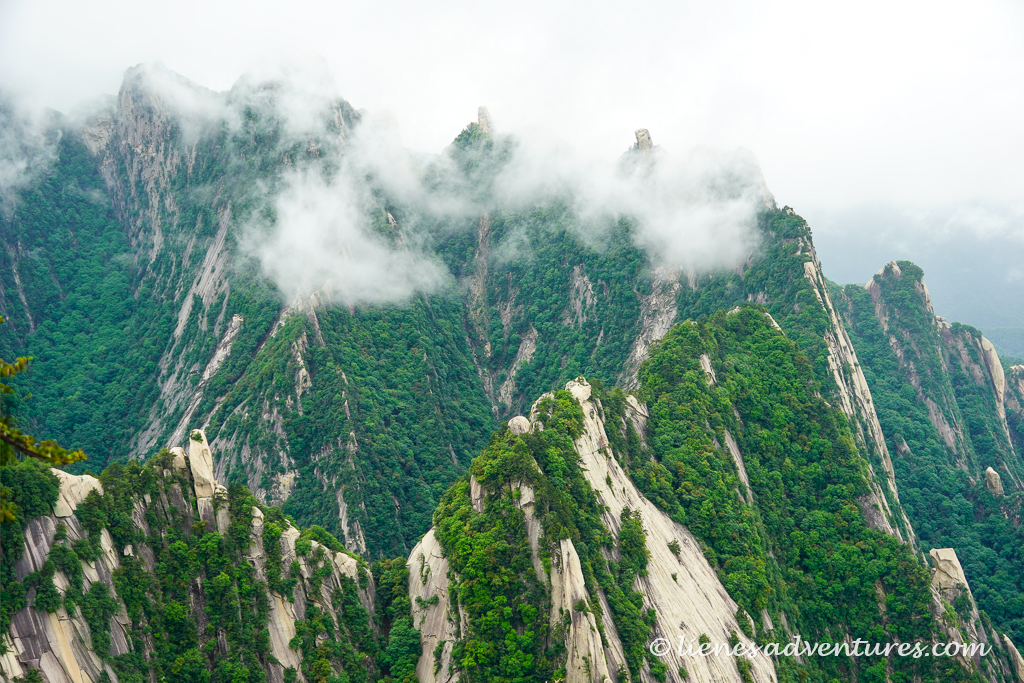
Plank Walk and Chess Playing Pavilion
After we were done with the photos at the South Peak, we started a rather long walk towards the East Peak. However, there were several famous sights along the way that we were eager to see before reaching the East Peak itself. The going was not too difficult, with both up and down sections along the route. But the views on this part of the route would take our breath away!
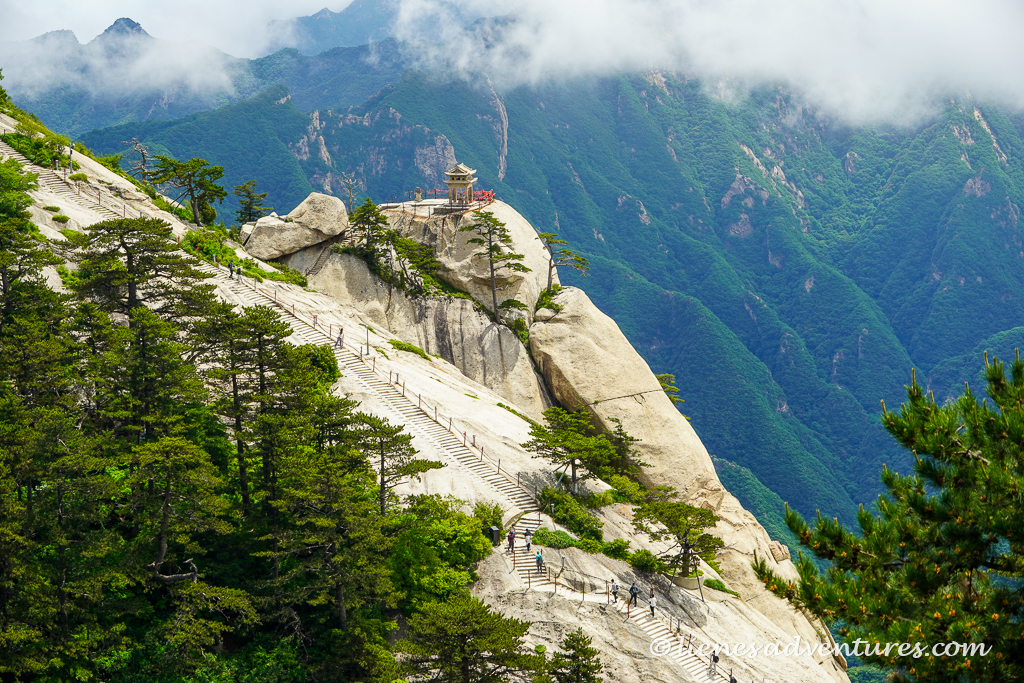
We could see far across the valley, looking at the cliffs on the other side and the trails we had yet to climb. It looked daunting from where we were standing, but we were determined.
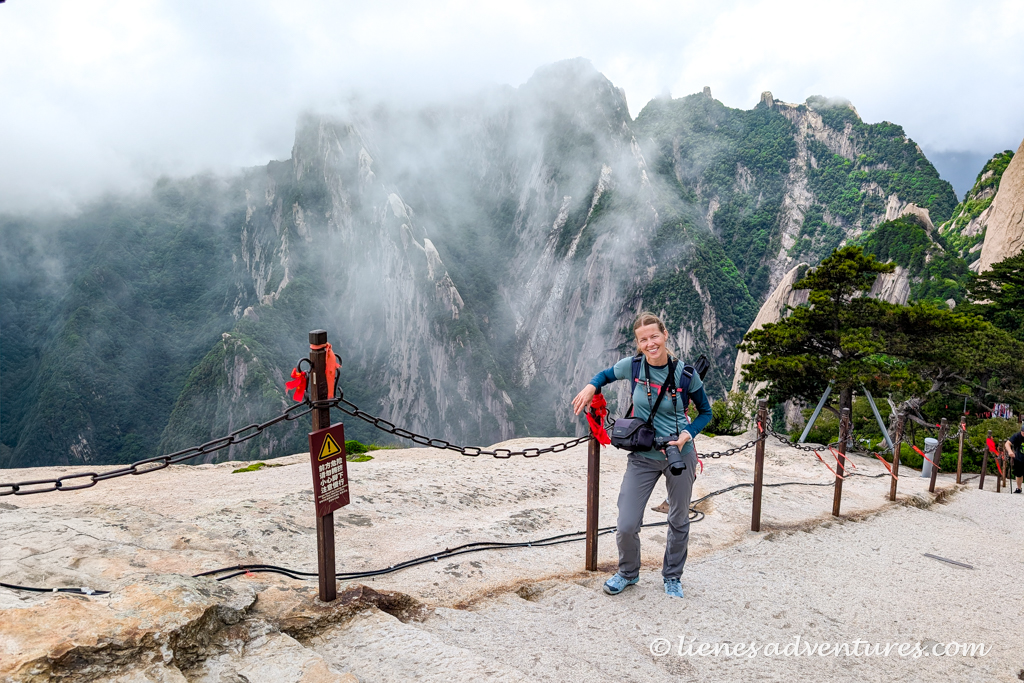
An attraction I was interested in seeing (but NOT trying) was the Huashan Plank Walk. It was first built over 700 years ago and reputed as the most dangerous hiking trail in the world. Just 30cm (12in) wide, the path consisted of wood boards and metal pins with no safety railing protecting daredevils from the bottomless abyss below. Many tourists came here to challenge themselves and feel the adrenaline rush.
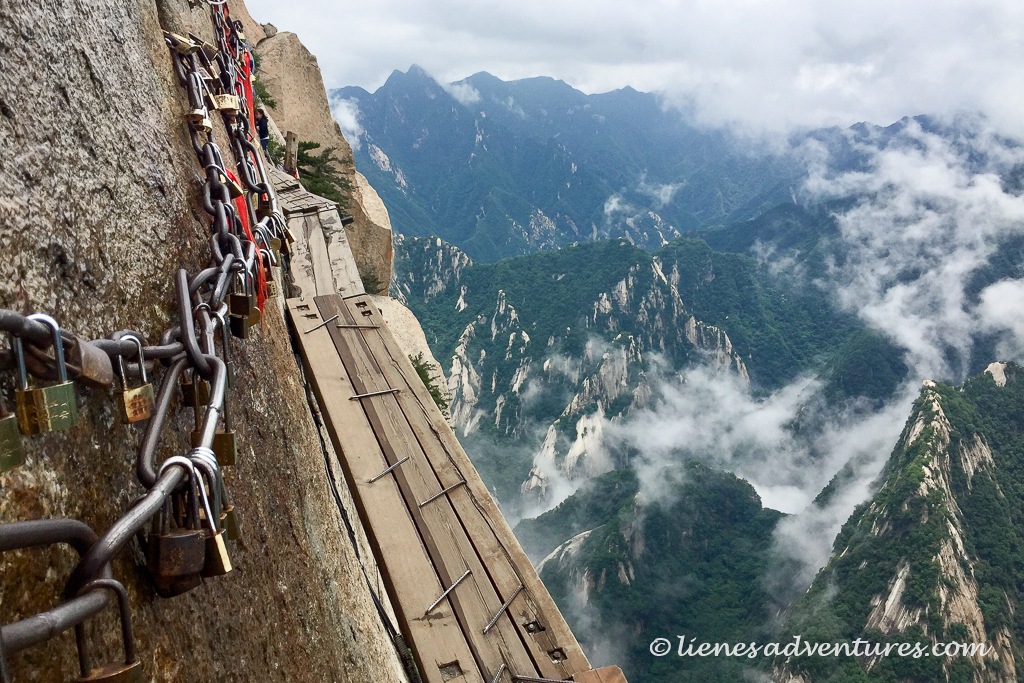
While it was 100% an attraction not for me, it was still amazing to observe. Needless to say, people have fallen to their deaths here… intentionally or not. With strict age and weight limits in place, my kids were sad to find out they were not allowed on the plank walk. I pretended to be sad along with them: “Maybe next time, boys, maybe next time… NOT!”
As we made our way farther, new scenery awaited us behind every bend and turn.
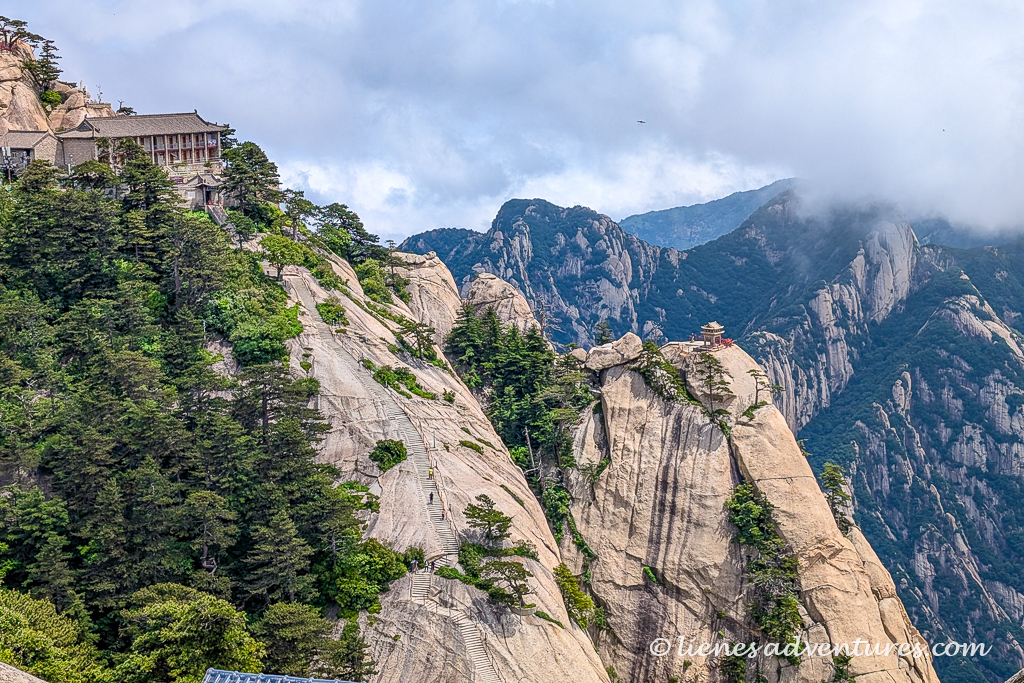
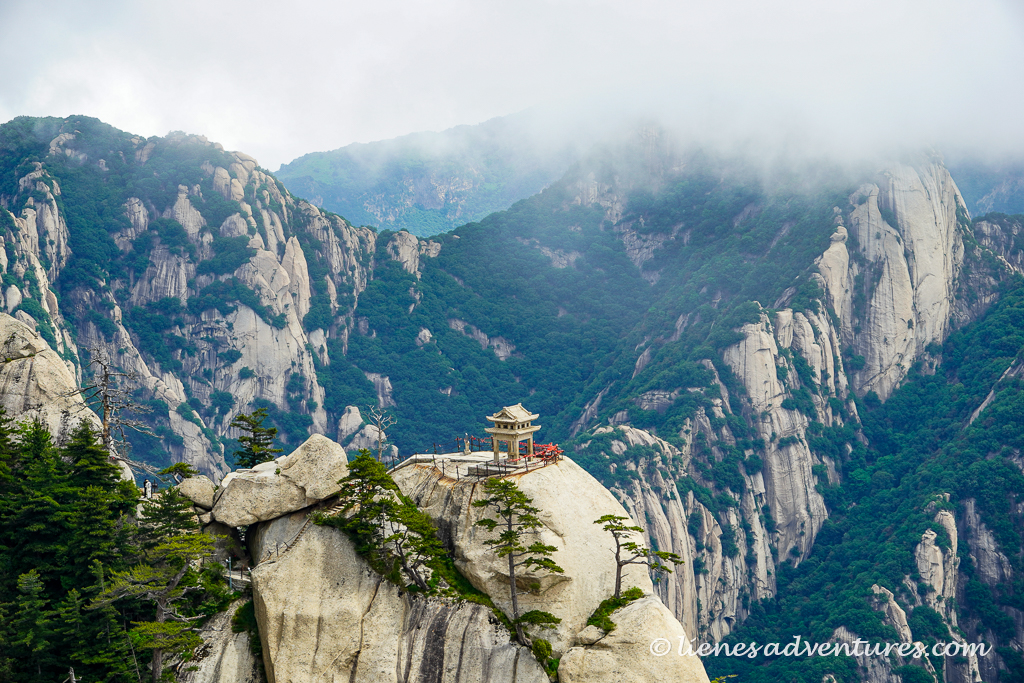
Eventually, we reached a spot called ‘Chess Playing Pavilion’. On an isolated peak called Botai there was a flat summit with a square stone that looked like a chess board. In Song dynasty, a pavilion was built over it, but the name stuck, hence the pavilion got its present name as Chess Playing Pavilion.
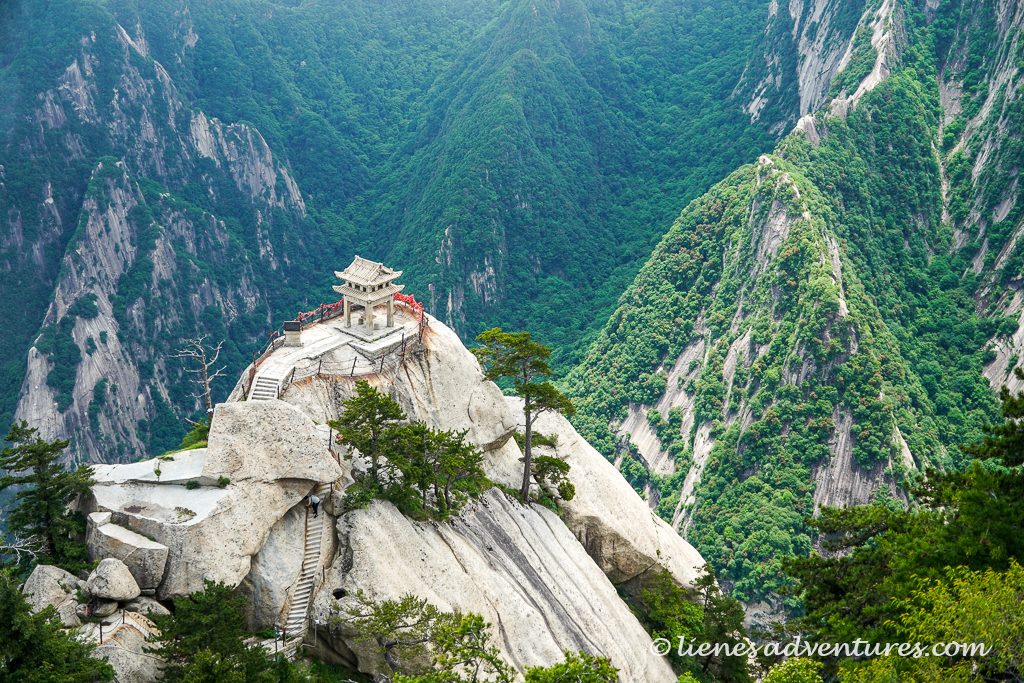
While it was possible to rent harnesses and climb the narrow path down to the Pavilion, we were perfectly content just observing it from the main trail platform. We sat down and watched the clouds roll in and out in between the mountain peaks… This became our favorite spot on the whole mountain with a vast, open and magical landscape.
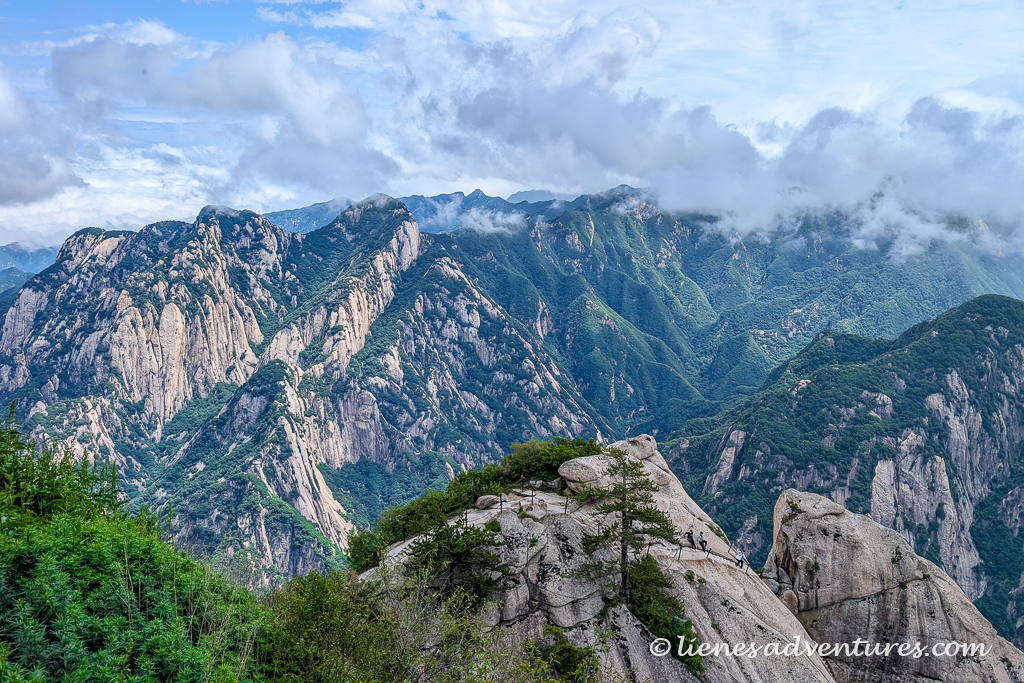
Here visitors could also find a simple hostel with several rooms (for those wanting to spend the night and get up early for East Peak’s sunrise), along with several simple restaurants and even a coffee shop. We were in no rush, so we sat down at one of the tables and ordered some lamb skewers for my husband and sausages on a stick for my kids. I got coffee and bubble waffles for dessert. It was the most perfect spot to enjoy some treats and let the world (clouds) pass by…
East Peak
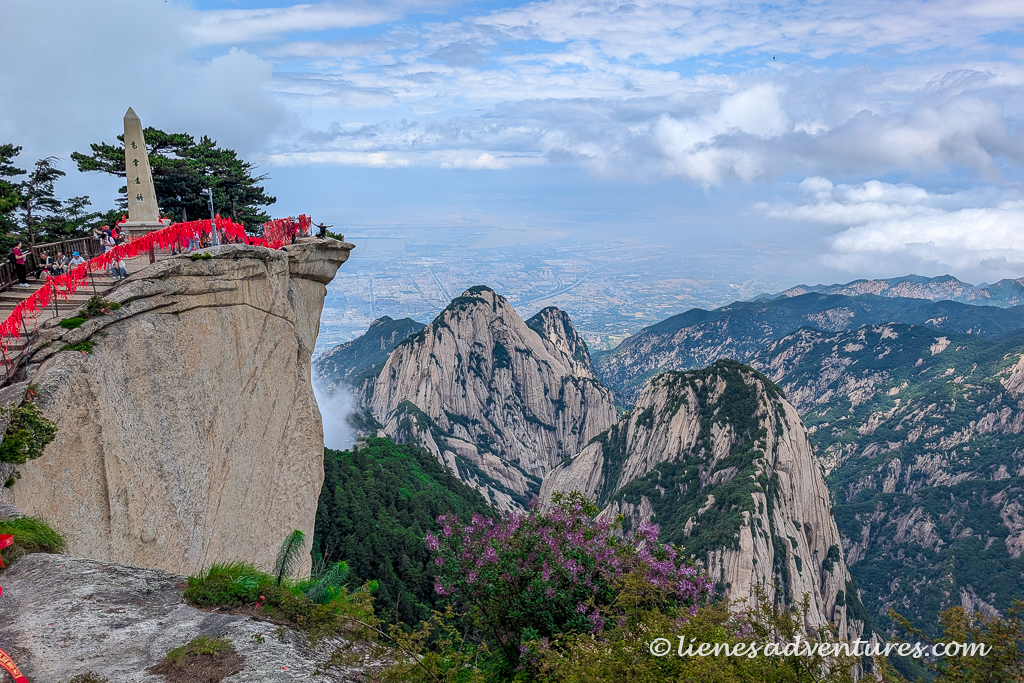
Just a short 5 to10-minute walk away was the 2096m (6876ft) high South Peak. Famous for its sunrise views, early afternoon was not exactly the right time of day to be here. But with mountain sunrise not on our schedule, this would have to do.
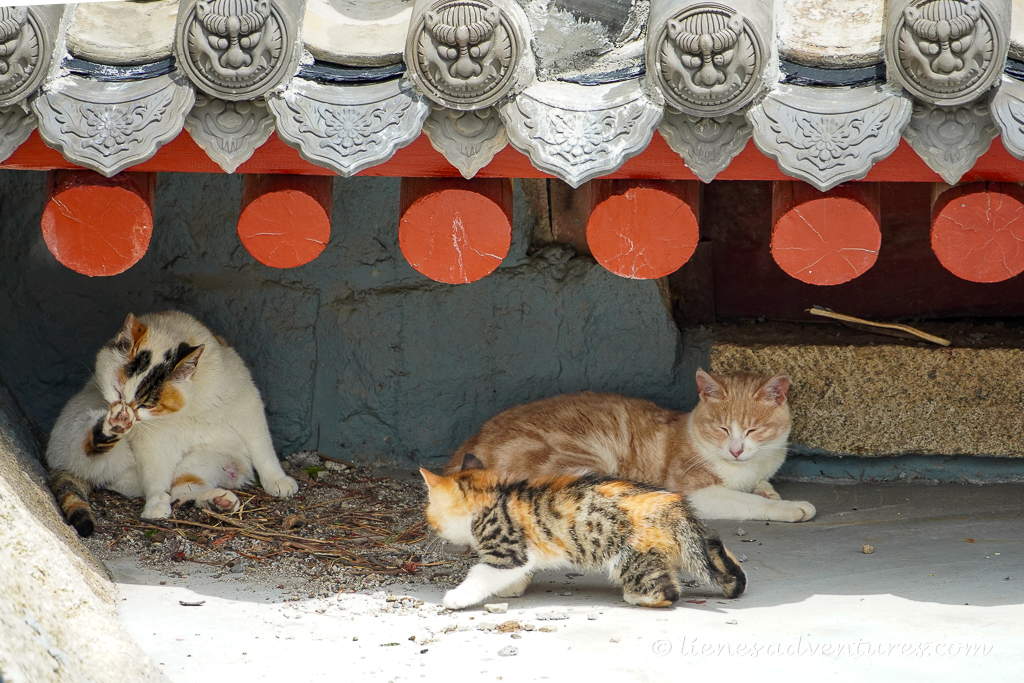
And who would have thought that even kittens felt right at home here at the top of the mountain! We suspected they must have belonged to one of the several temples here.
North Peak
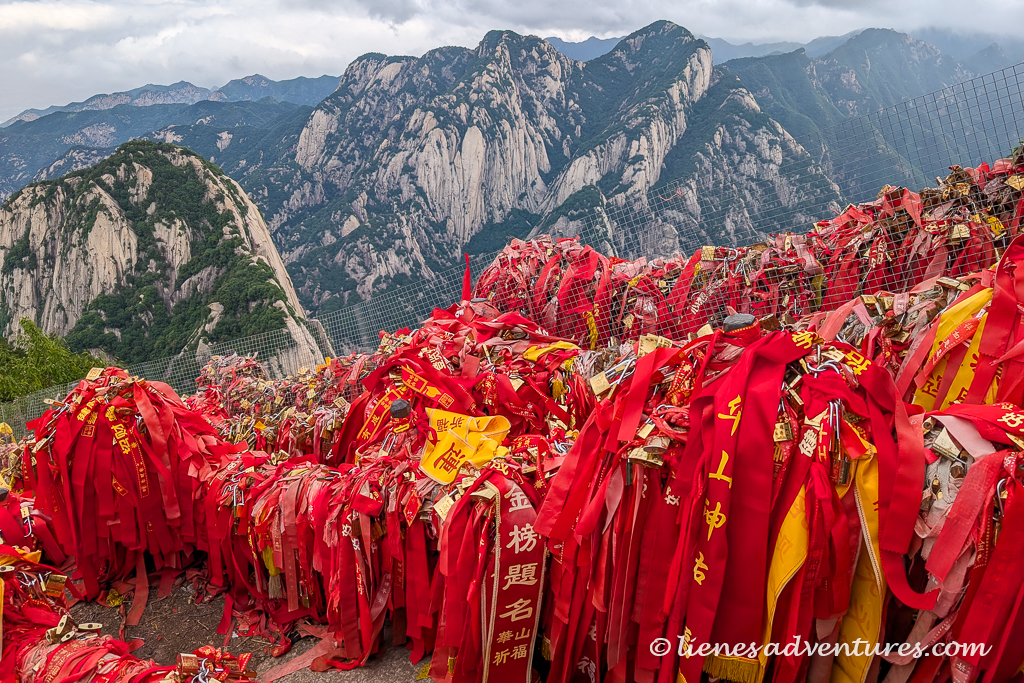
From here, we started a rather long downhill walk towards the North Peak. With it sitting only at 1614m (5925ft) in elevation, it was considerably lower than the other peaks. So we had to descent nearly 500m (950ft) downhill on carved stone steps. While it was not a big issue for me, people with hip or knee problems might find this section very monotonous and hard on their joints. All along the way we saw thousands of red ribbons tied everywhere. In Chinese culture red represented luck and happiness, and tying red ribbons was a symbol for love, protection and good wishes.
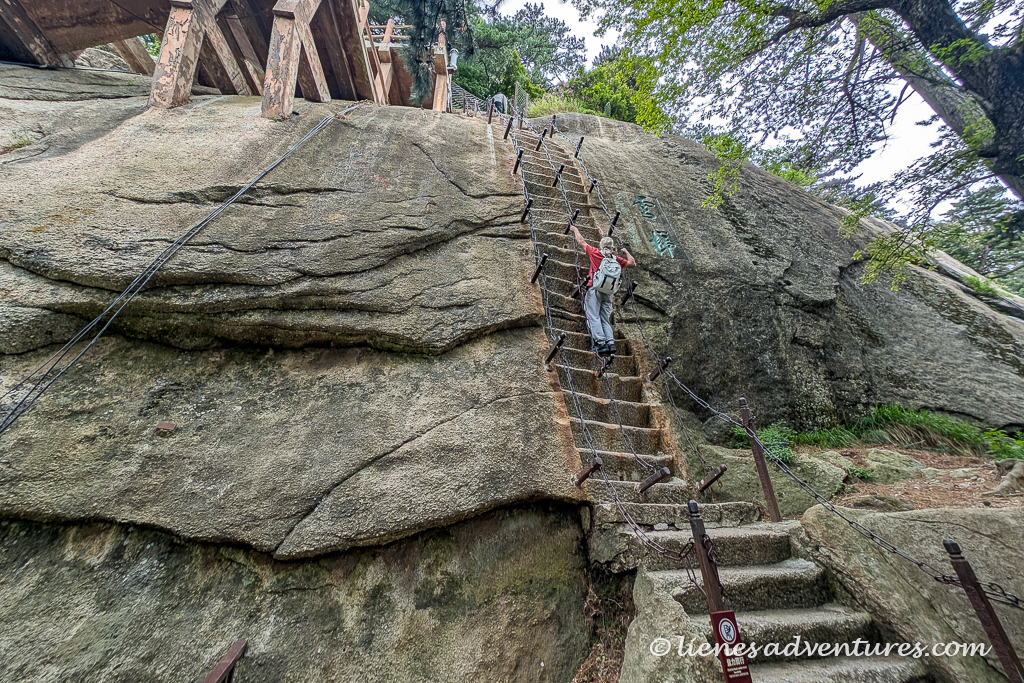
As we continued downwards, we bypassed a stone ladder. However, once my kids saw that it was an option to climb it, they used all their charm to talk me and my husband into allowing them to climb the stone ladder. Eventually, we gave in and let each boy take a turn climbing the vertical steps. It was a calculated risk, and all was well.
As I mentioned earlier, going downhill to the North Peak also allowed us to bypass the Canglong Ridge which I had no interest in climbing. Due to safety reasons, Canglong Ridge had been made a one-way hike in the recent years, and only people going upwards used it, while people going down bypassed it on a side trail. I was perfectly fine with that.
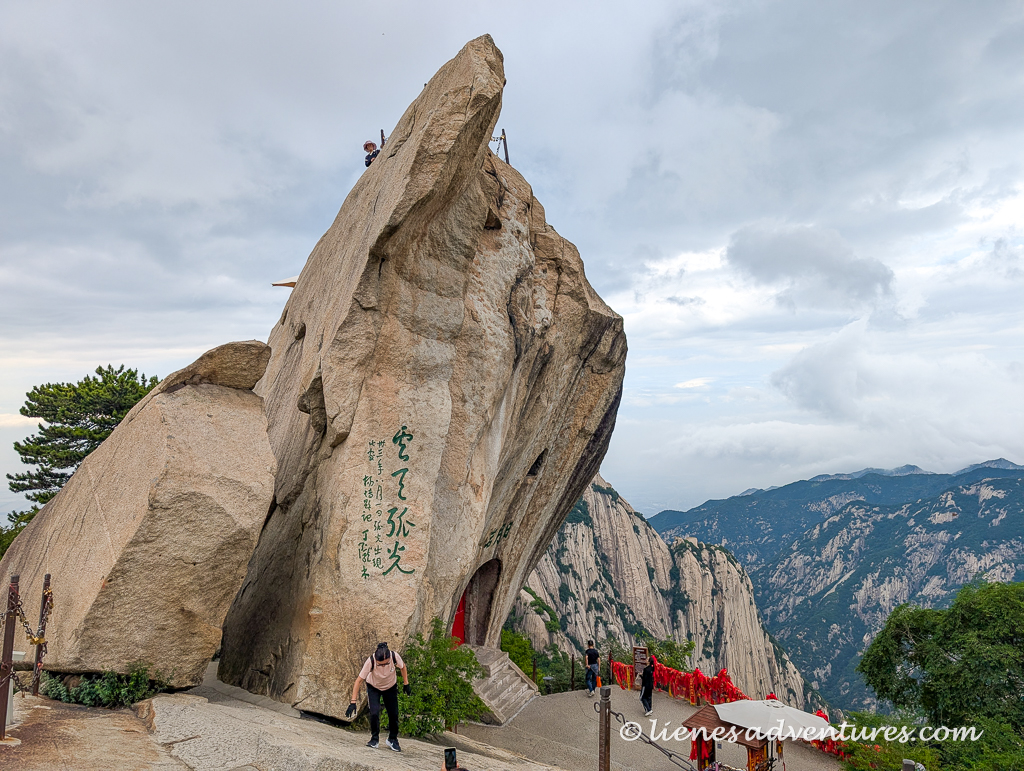
Once we reached the North Peak area, my kids had lost all their zest and were too tired to officially make it to the Peak’s marker stone. “Too many rocks,” they said! Instead, they were more interested in the ice cream and smoothie stands. Fair enough, it had been a long day. So, while I attempted my last official summit, my husband stayed back with the kids scouting out the snack stands.
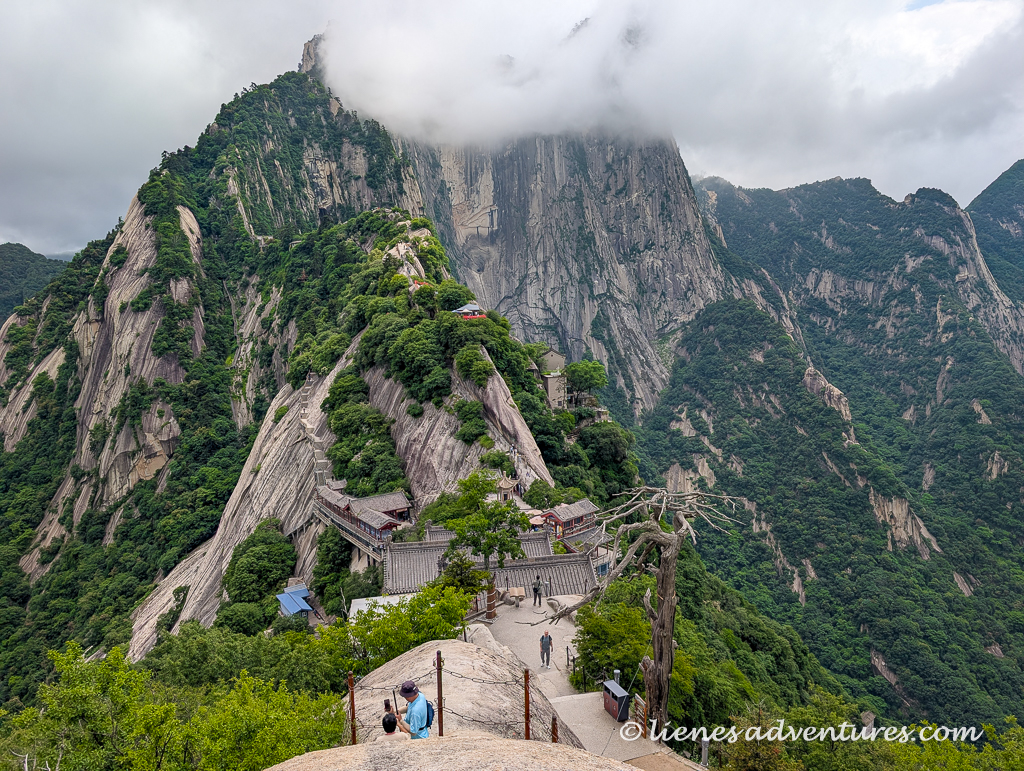
I, however, officially checked off the North Peak summit and then joined my team for a ride down the mountain.
North Cable Car (down)
Very conveniently, the cable car tickets could be purchased right at the station on top of the mountain. And as we got the tickets, we immediately hopped on the next available gondola. With only 1.5km (1mi) in length, it was nearly 3x shorter than its West counterpart; and not nearly as scary! This time I could even enjoy the views.
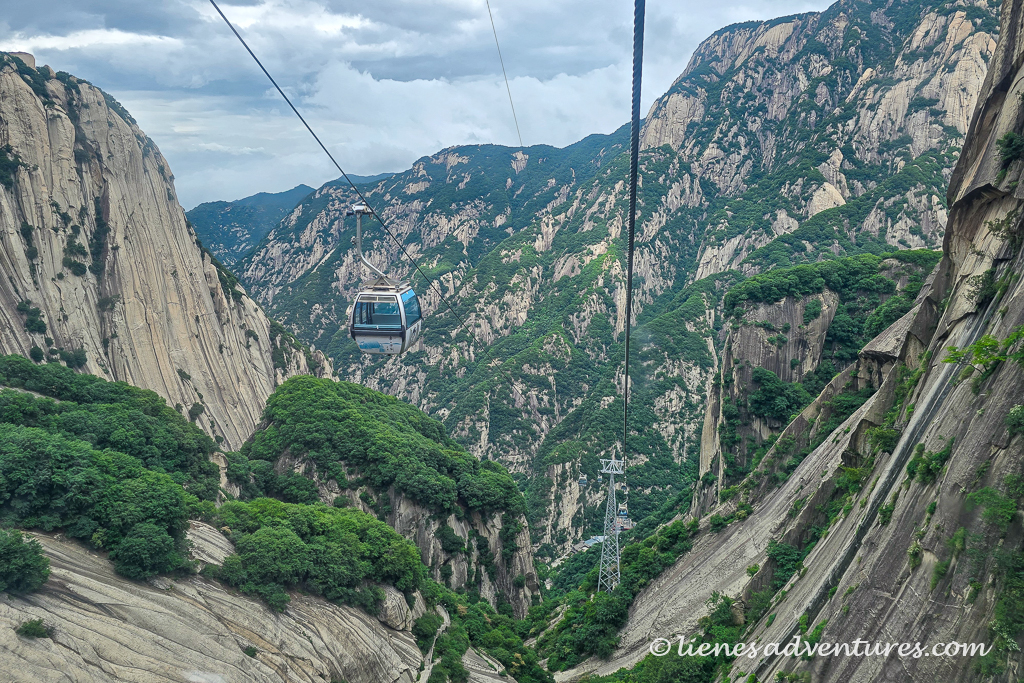
However, to be honest, if I could only take one cableway here, and I had to choose - I would say the West Cableway was more impressive and scenic, albeit much scarier.
At the bottom of the North cableway station, we had to get on yet another shuttle that would then take us back to the main Huashan Tourist Area where we started our adventure in the morning.
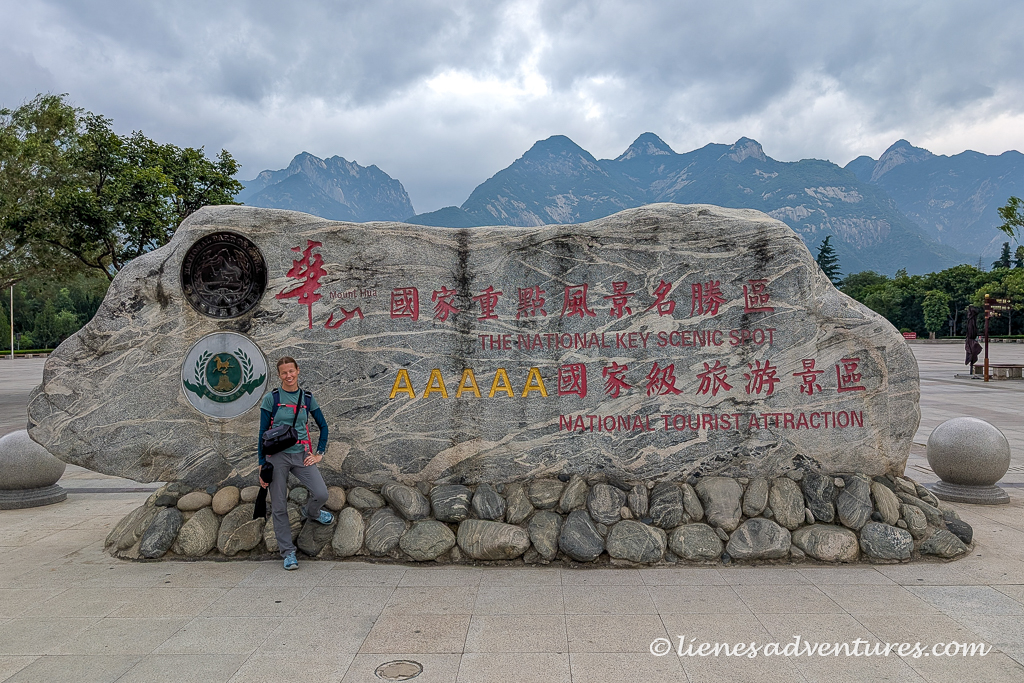
As I had my Garmin tracker running all the way through our hike at the top of the mountain, our stats were as follows:
- total distance walked from West Peak to North Peak 7.2km (4.5mi);
- elevation gained 411m (1350ft);
- descent 845m (2770ft);
- total time spent on the mountain 5.25hrs (including photo stops, rest stops, bathroom stops, eating stops etc).
With this, however, our Mount Huashan adventure was officially in the books. And it was amazing! The scenery of this mountain was something we still talk about frequently.
The last task of the day was to find dinner. And the Visitor Center had a food court with plenty of options serving several local specialty dishes. We settled on a bowl of noodles with beef which were warm and hearty after a long day’s hike.
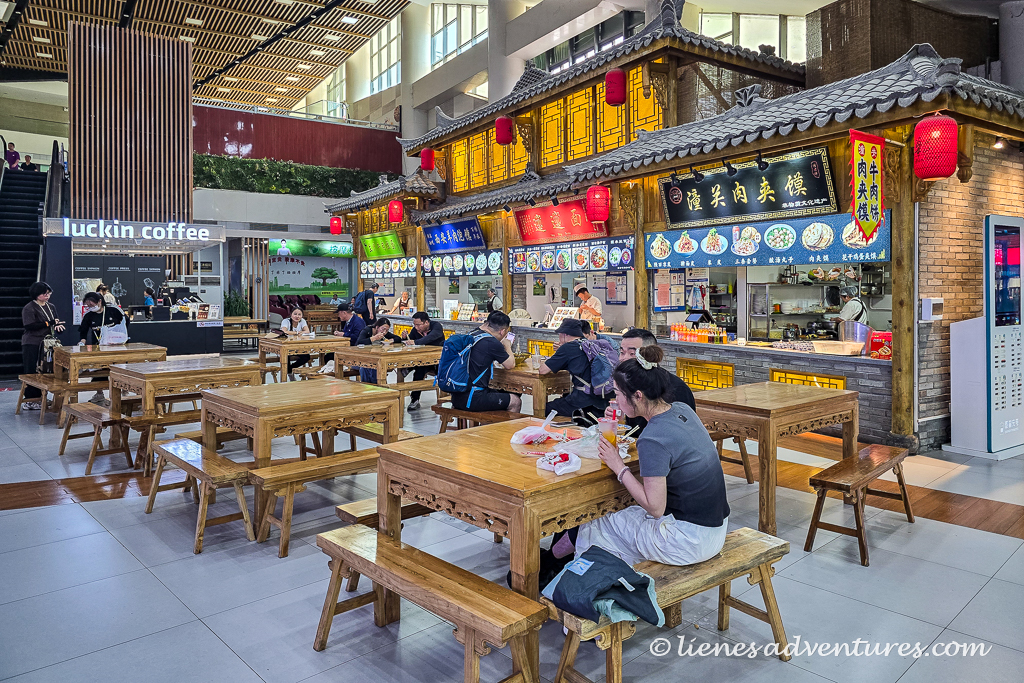
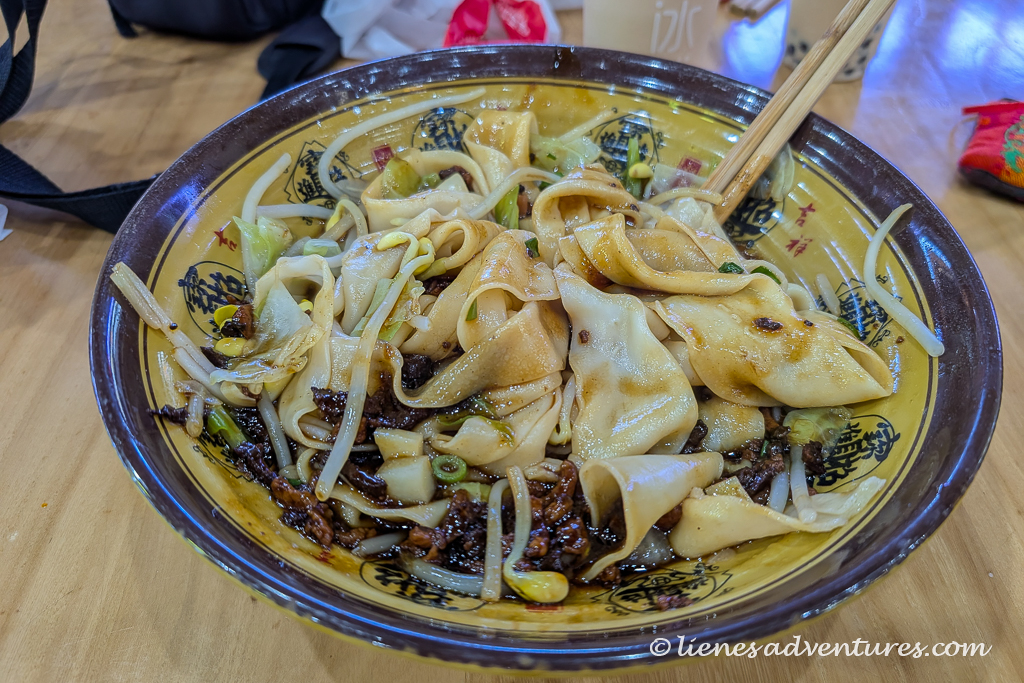
And how lucky were we to have such a beautiful, warm day without a drop of rain when the weather forecast called for nothing but rain?! This, however, presented an odd problem… As we had conquered all the peaks of the mountain in one day, it left nothing to do for our next day here in Huayin. And we had a full day at our disposal. On our ride back to the hotel, we chatted with the hotel owner about some other attractions we could do in the area. A few ideas were thrown around, but nothing really stuck. Upon Google search, I realized just how close we were to the famous Terracotta Warriors! It was just 90km (56mi) away! I checked in with the hotel owner, and he said he would get us a driver for the next day - all we had to do was say what time we wanted to leave! And that’s how our plan was set.
DAY 3 – THE TERRACOTTA WARRIORS
As agreed, our limousine (a taxicab) was outside the hotel door waiting for us at 8AM sharp. For 600rmb ($87), we had a private door-to-door car and driver service for the whole day who would take us to the Museum, wait for us, and then drive us back in the afternoon.
The 1-hour drive was quite uneventful, and soon we found ourselves standing in front of the famous Terracotta Warriors (officially - Emperor Qinshihuang's Mausoleum Site Museum). Before we even managed to purchase the tickets, we were surrounded by guide offers. While initially we did not plan on hiring a guide, we let ourselves be talked into one… As I had not pre-planned our trip here and it was a last-minute decision, I did not have much knowledge about the place - how to better see it, where to go, what to skip etc. So, hiring a guide seemed like a wise idea. An English-speaking private guide for 2 hours cost us 300rmb ($45). And while sometimes it could be a hit or miss, ours was definitely a hit! Her knowledge was not just that of dry facts and books, but also local stories and fun events that kept even our kids entertained.
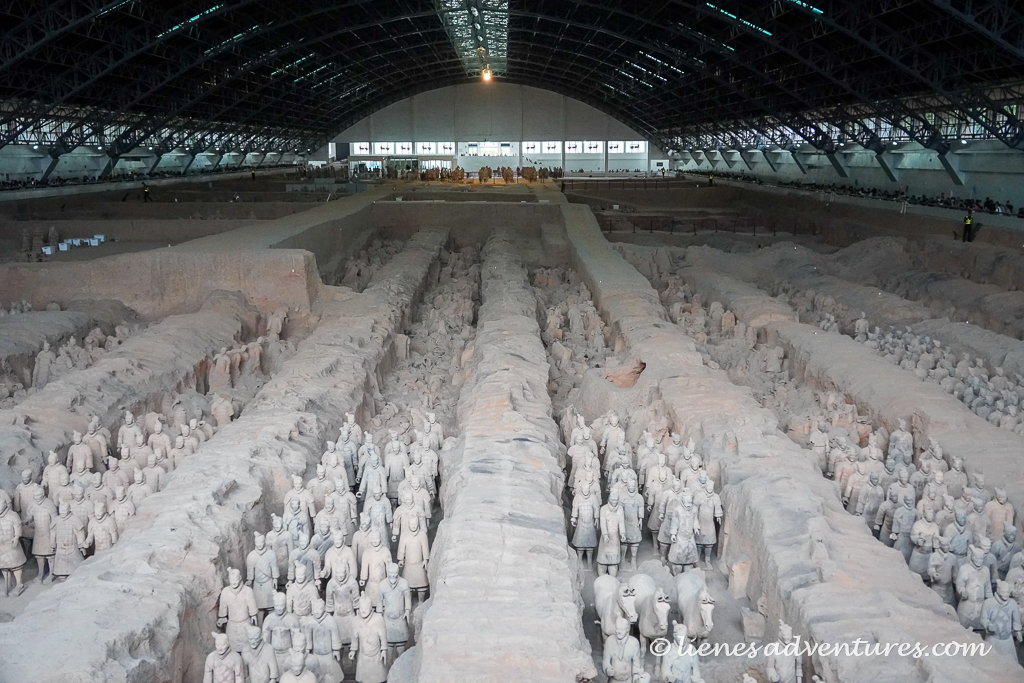
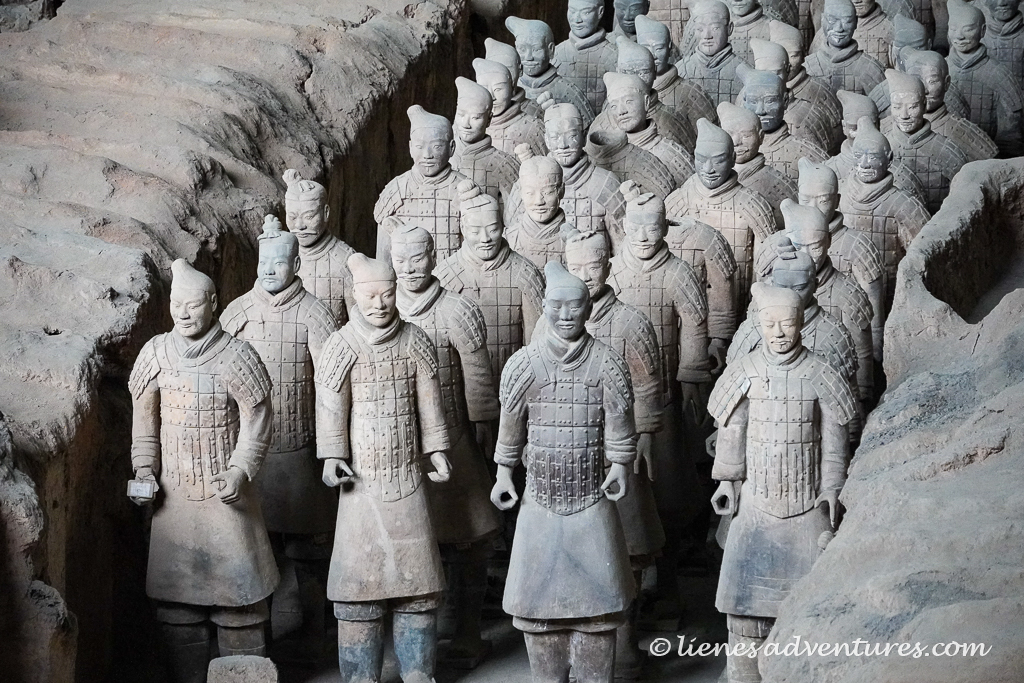
Of course, we started the tour with the famous Pit 1 that was discovered by a farmer in 1974. An underground army of nearly 8,000 life-size terracotta figures was known as one of the greatest archaeological finds of the 20th century. The farmer who discovered the warriors was now the honorary director of the Museum.
When I laid eyes on the Terracotta Figurines for the first time, it was like an unreal experience. It was something that I learned about in history lessons, something that I saw in pages of books, something that National Geographic showed in their documentaries… And here I was, looking at it with my own eyes, standing an arm’s reach away somewhere in Shaanxi Province, China. Who would have ever thought?!
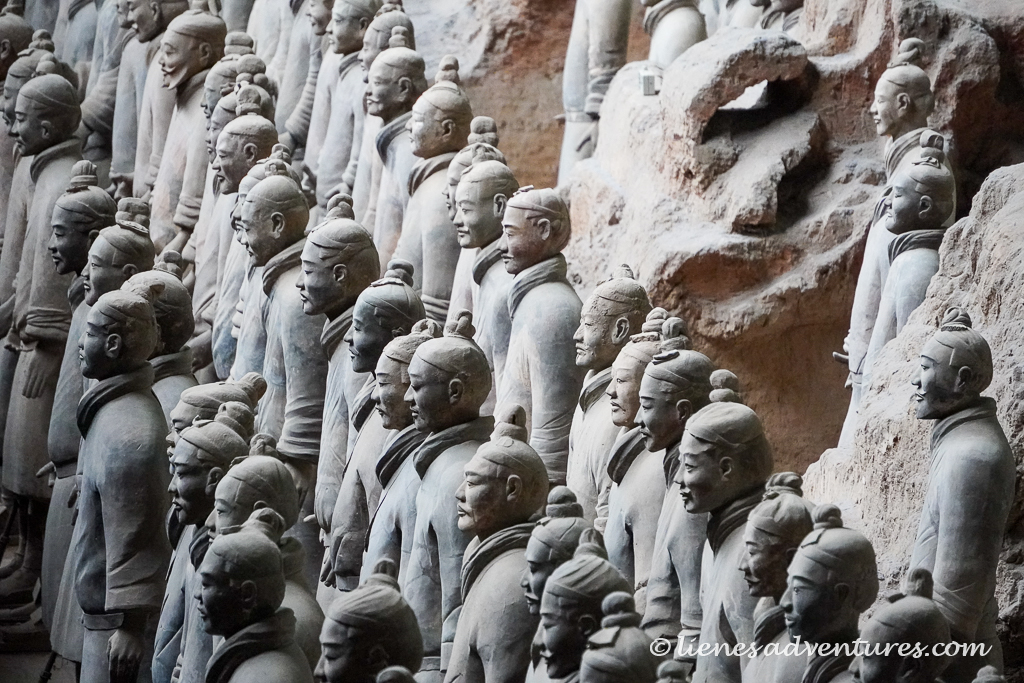
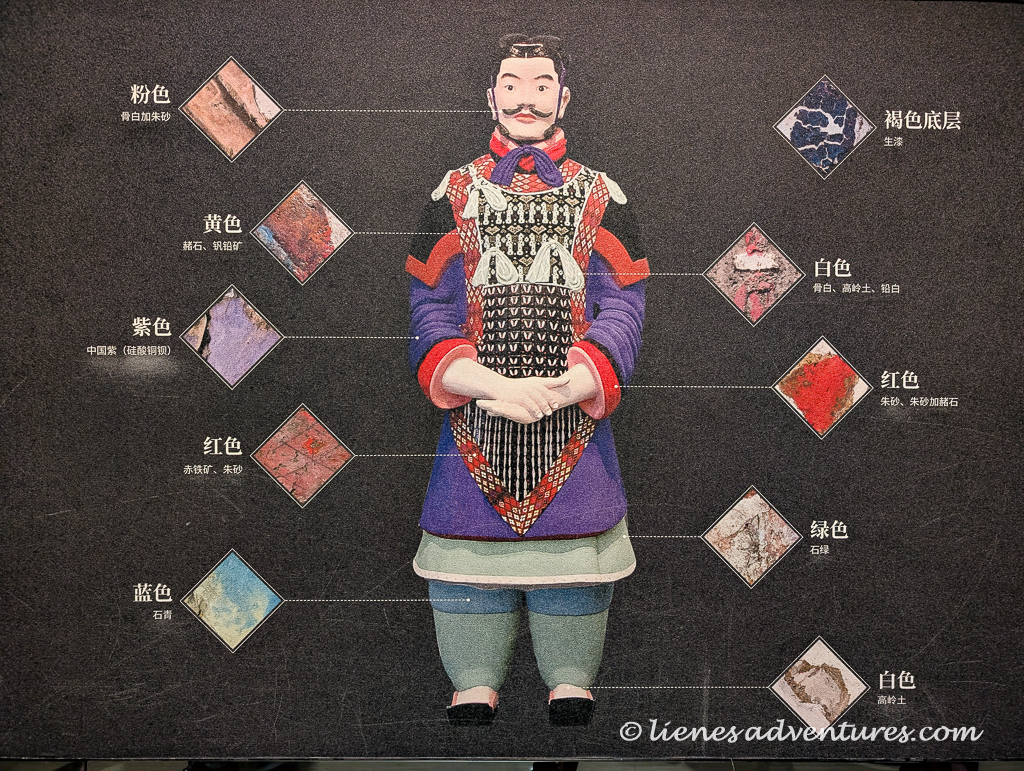
While we were used to seeing these warriors only clay-colored, they actually had colorful outfits when they were first discovered. Unfortunately, the paint quickly deteriorated and peeled off once the figures got exposed to oxygen and sunlight.
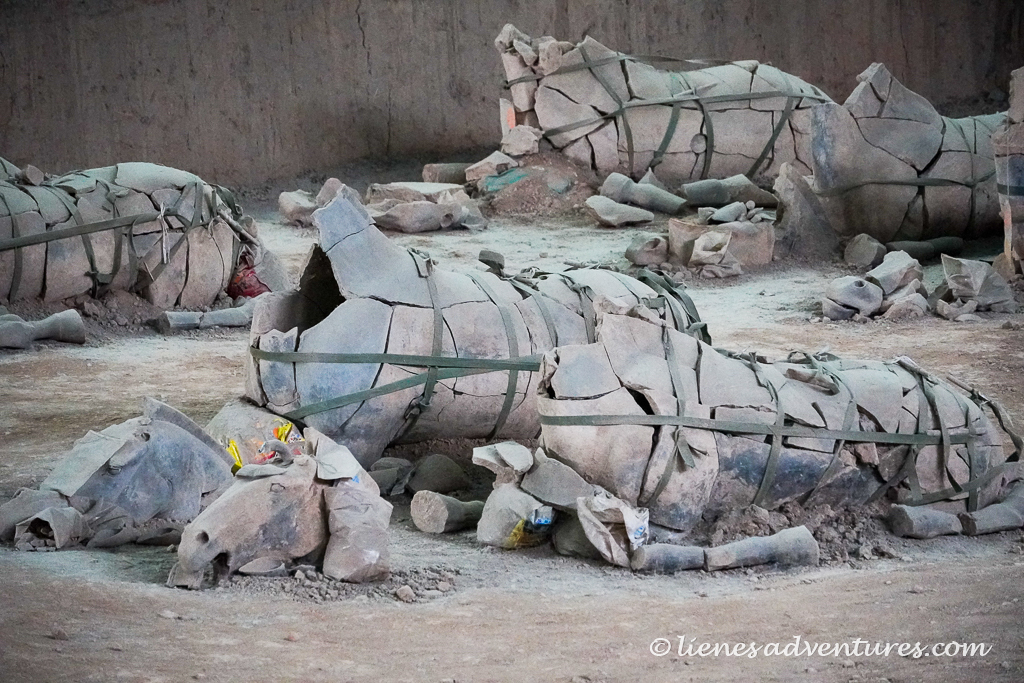
Many of the sections of the Pit were still yet to be unearthed. Our guide said it could take archeologists up to 6 months to dig up and put together 1 warrior, depending on its state. We saw several archeological pieces in different stages of completion.
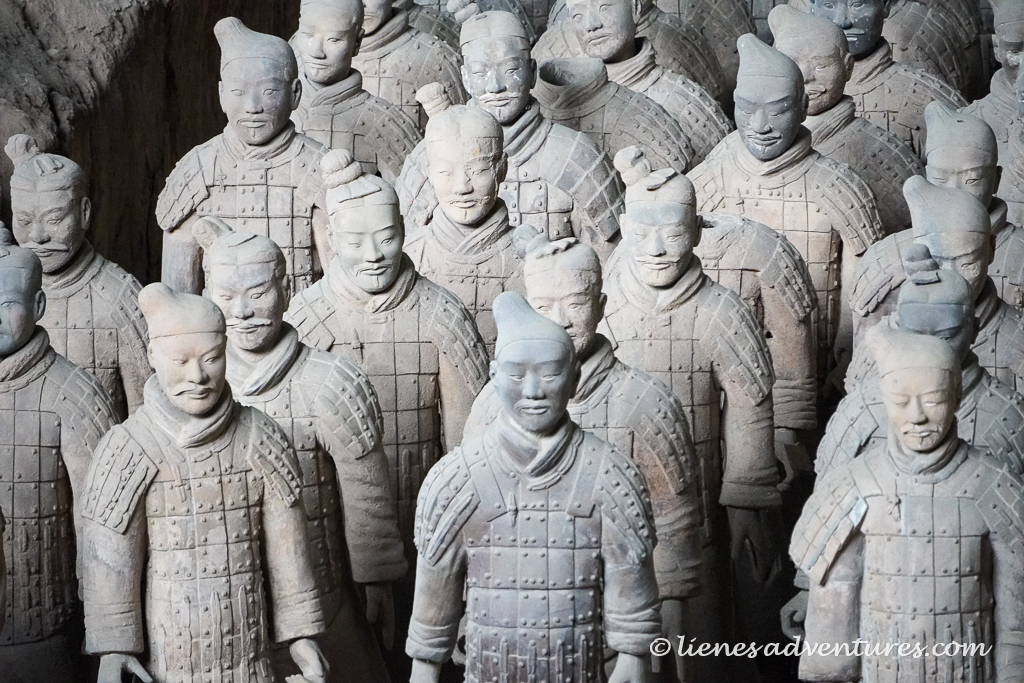
It was also a well-known fact that each one of the warriors had different facial features, different build and varying expressions. The guess was that the workers made these warriors in each other’s image, making each one of them unique.
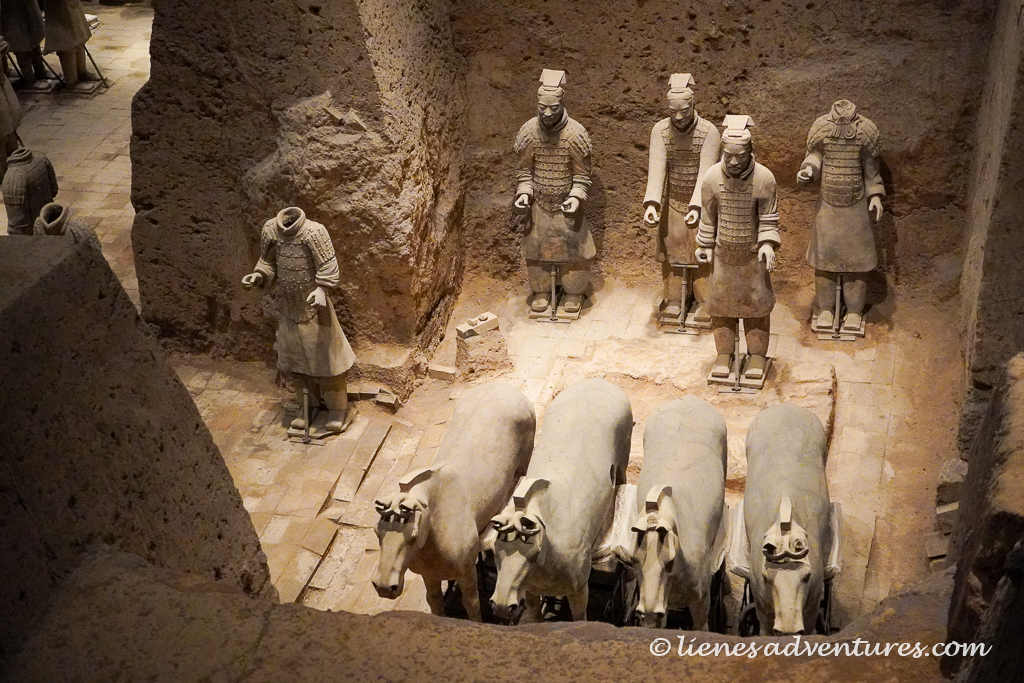
Pit 3 housed the famous horse chariot with higher ranking officials. While the horses and officers were preserved, the wooden chariot along with weapons had long disintegrated and there was nothing archeologists could do to bring them back.
Pit 2 warriors were still almost completely covered up with no plans in near future to start any major work. The pit was encapsulated under the museum building, protecting it from outside elements and safeguarding it for the new generation of archeologists yet to come.
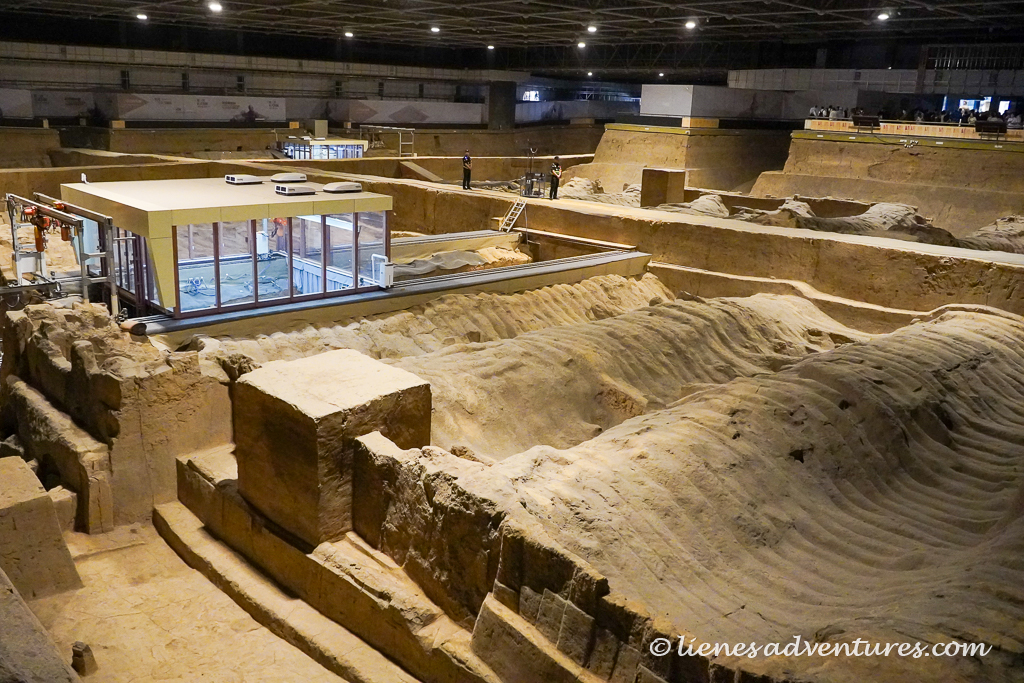
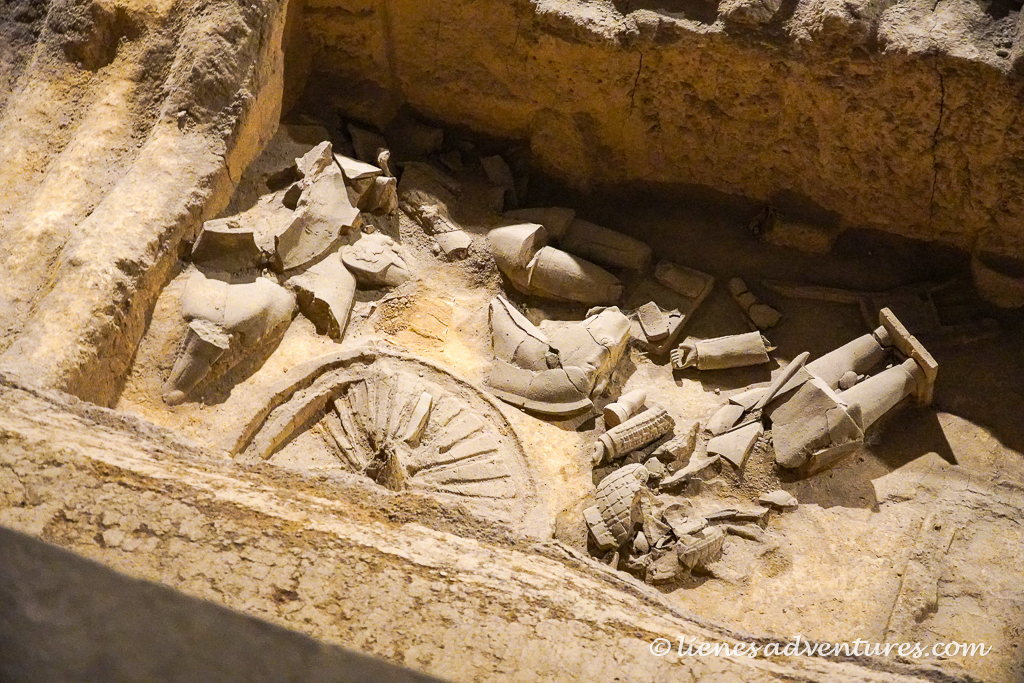
There was just too much work still to be done in Pit 1, that Pit 2 would have to wait…
Our guide said that the teams were certain there were other areas underground with more warriors that they yet had no knowledge about… but they would be discovered one day.
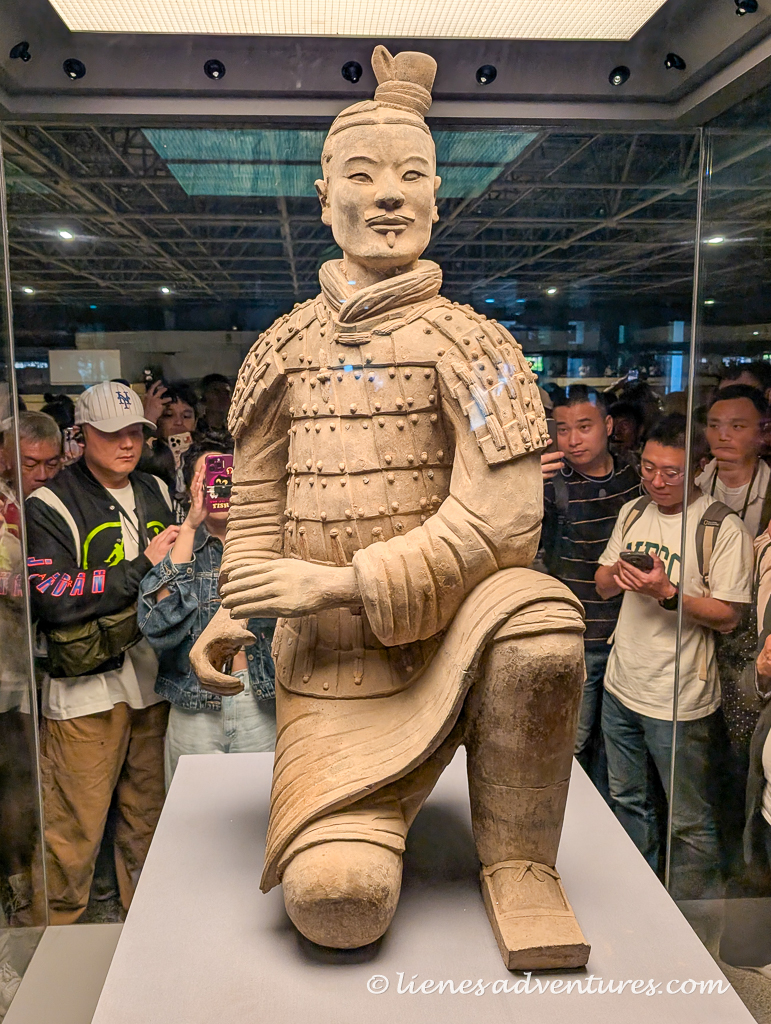
After completing our tour with the guide, we headed towards the indoor museum which had various artefacts and interactive exhibits. Here we could see a model of a warrior in the colored clothing the archeologists had determined some of them might have been wearing. It was very interesting to see, as this was not how people usually pictured the Terracotta Warriors.
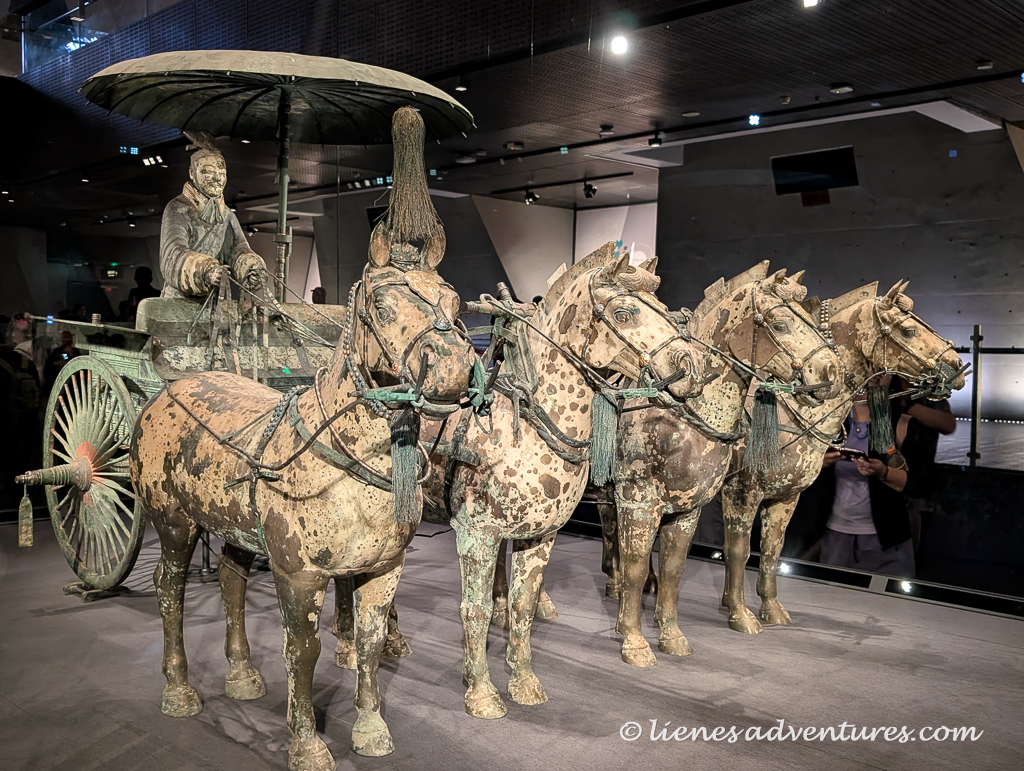
A lesser-known section of the Terracotta Warriors Museum was Lishan Garden. Included in the ticket price, we had to hop on a 10-minute shuttle bus that took us there. This expansive area included the Mausoleum of the First Qin Emperor and various archaeological sites, the most famous of which - the Bronze Chariot and Horse Pit. While all the warriors and horses at the main site were made of clay, here they were of bronze, including the carriage.
An interesting fact told to us by the guide: the actual tomb of Emperor Qin has not been unearthed or opened, because various scans and images of it showed many trap doors, anomalies, and complicated layers of protection. One of them – mercury. And with the knowledge that we have nowadays, nobody wanted to risk a leaking mercury. Hence, the decision was made not to attempt to open the tomb.
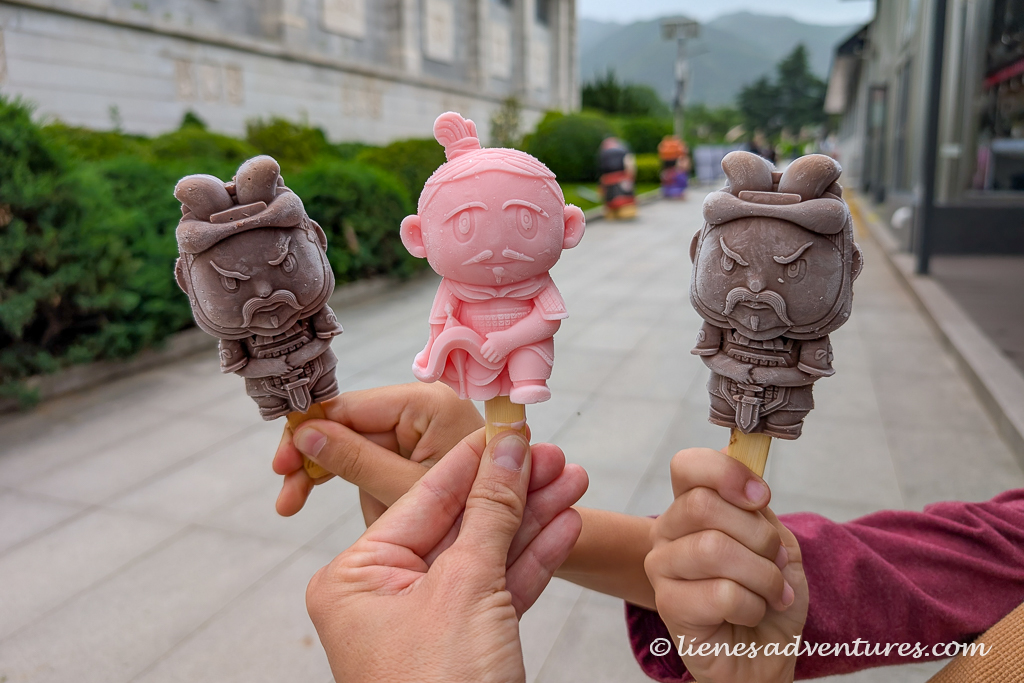
Overall, our visit to the Terracotta Museum had taken us much longer than we originally anticipated. By now, it was already late afternoon, and we started receiving messages from our driver asking if we were okay… I think that was a hint that we needed to wrap it up. On our way out, we grabbed some Warrior-shaped ice creams (a thing China does at every famous attraction) to commemorate the experience.
DAY 4 – BACK HOME
As I opened my eyes on the last morning and walked out on the balcony, the majestic Mount Huashan looked right back at me.
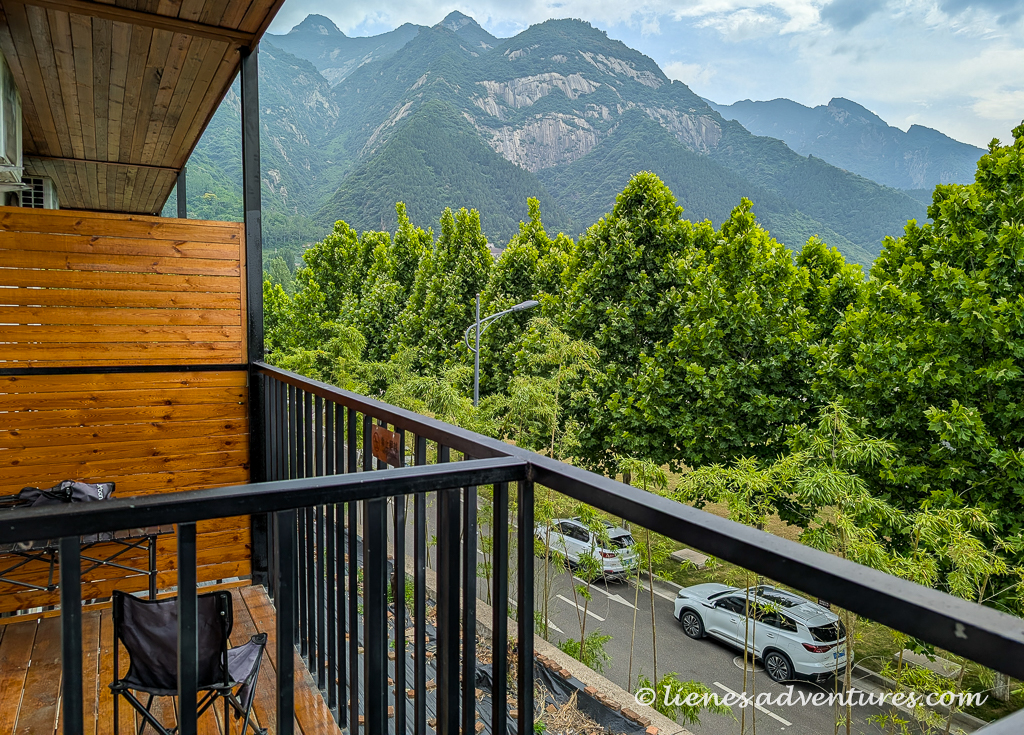
What a fun time we had here – with both planned and also unexpected adventures. We took one last look around, walked out onto the porch for the last few photos, and then got a call from the hotel owner – he was ready to drive us back to the train station. I could not have asked for a more amazing weekend!
To read more about our travels around China, click here:
CHENGDE - IMPERIAL GARDENS AND TIBETAN TEMPLES. A WEEKEND TRIP FROM BEIJING
DAY TRIP TO TIANJIN CITY FROM BEIJING, CHINA
CHINESE NEW YEAR AT PINGYAO ANCIENT CITY (AND A VISIT TO WANG FAMILY COMPOUND)
3 DAYS AT HARBIN INTERNATIONAL ICE AND SNOW SCULPTURE WINTER FESTIVAL IN CHINA